WASHINGTON – Leaders of both parties expected quick passage Thursday as the Senate neared a vote on President Obama’s request for congressional backing to train and arm Syrian rebels battling Islamic State militants.
The measure sailed through the House on Wednesday as Obama won support from staunch Republicans who typically oppose him but lost votes from some of his most loyal Democratic allies in a 273-156 House tally. Republicans backed Obama by a more than 2-1 margin; Democrats backed him as well, but to a lesser degree.
Top leaders of both parties stood with the president despite reservations that his strategy of arming moderate rebel groups could backfire or won’t be enough to blunt the advance of Islamic State forces. Obama has pledged airstrikes as well but is adamant that he won’t send U.S. combat troops to battle the Islamic extremists in either Iraq or Syria.
“We must pursue a comprehensive and sustained counterterrorism strategy, and a bipartisan coalition in the House voted to support a critical component of that strategy,” Obama said after the House vote.
Rand Paul, R-Ky., a potential presidential candidate in 2016, took the opposite tack, warning his Senate colleagues on Thursday that they were sending aid to bad actors and would only further destabilize an already chaotic region.
“Intervention when both choices are bad is a mistake. Intervention when both sides are evil is a mistake. Intervention that destabilizes the Middle East is a mistake,” he said on the Senate floor. “And yet, here we are again, wading into a civil war.”
The Senate was voting late Thursday on the measure, which was added to a must-pass, stopgap spending bill to keep government agencies operating into December.
The measure is the last major business on Capitol Hill before lawmakers return to their districts and states to campaign for re-election.
The new authority is part of $500 million that Obama requested in May to train and equip Syrian rebels. The cost, to be covered by leftover war funding from this year, generated virtually no debate among lawmakers, who focused instead on the possible consequences of a new military mission not long after a war-exhausted nation largely pulled out of Afghanistan and Iraq.
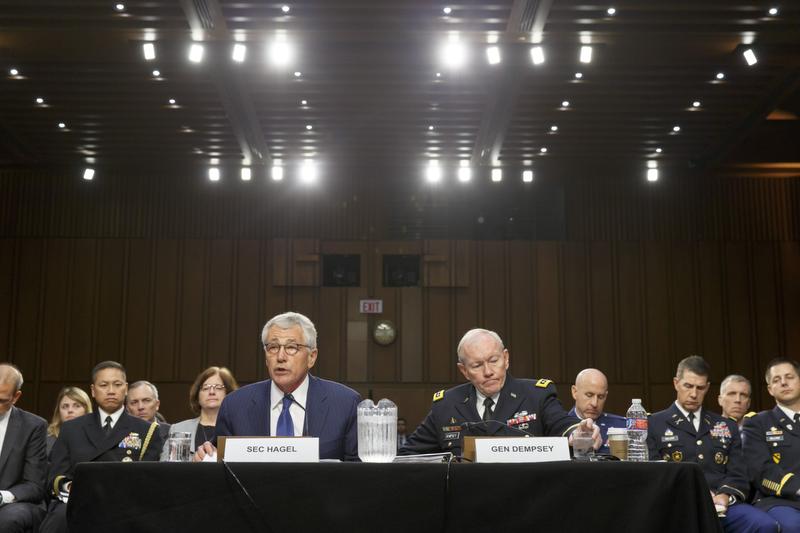
Meanwhile, Defense Secretary Chuck Hagel and Secretary of State John Kerry testified before House committees.
Testifying before the House Armed Services Committee, Hagel said the military had presented a detailed Syrian plan to Obama on Wednesday during the president’s visit to Central Command and was awaiting his sign-off.
“The president has not yet approved its finality,” Hagel said.
At a House Foreign Affairs Committee hearing, Kerry sought to push back on an argument by some in Congress that Syria’s rebels lack moderates, or at least any with the capacity to make a difference in the war. He spoke about several opposition groups, each including up to 4,000 fighters, that have battled Islamic State militants and other extremists over the past year.
Kerry said the coalition that will fight the Islamic State counts 50 countries. He said countries in Europe, the Arab world and elsewhere had committed to taking part militarily, without specifying any by name. He said a couple of countries “are already flying with us” in missions.
Kerry said the administration understood the danger of a “slippery slope.” That’s why, he said, the U.S. was determined to build a genuine coalition, “not a fig leaf,” that involves countries making significant contributions in battling Islamic State militants.
Despite their doubts, top Republicans saw little choice but to back the president. The measure provides Obama the authority to train and arm rebels through Dec. 11, ensuring the issue is debated at greater length in a postelection lame duck session.
“While I’m concerned about the ability of the coalition to generate sufficient combat power to defeat ISIL within Syria, I do support the president’s proposal to begin the program,” Senate GOP leader Mitch McConnell of Kentucky said Thursday.
Democrats proved to be a harder sell, backing Obama 114-85 in the House.
“We simply don’t know if somewhere down the line it will turn our guns back against us,” said Rep. Loretta Sanchez, D-Calif., giving voice to a fear that rebels seeking the removal of Syrian President Bashar Assad would prove unreliable allies eventually.
In the Senate, backing from the top Democratic and Republican leaders ensures swift passage, even as some in the rank and file were lining up against the effort.
“I have seen no evidence that the Syrian rebels we plan to train and arm will remain committed to American goals or interests,” Sen. Joe Manchin, D-W.Va. Bernie Sanders, I-Vt., also came out against the measure.
The underlying spending bill prevents a government shutdown at month’s end and also renews the charter of the Export-Import Bank, which helps finance purchases of U.S. exports. That postpones until June a battle between tea party forces opposing the bank and business-oriented Republicans who support it.
The legislation also includes $88 million to combat the Ebola outbreak in West Africa.
The underlying bill passed the House on a vote of 319-108.
Associated Press writers Bradley Klapper and Donna Cassata contributed.