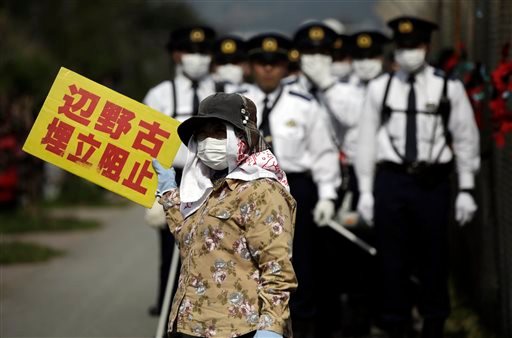
TOKYO — The governor of the southern Japanese prefecture of Okinawa said Wednesday that he would head to Washington to convey local objections to a plan to relocate a U.S. air base.
A plan set in 1996 would move U.S. Marine Air Station Futenma to a less developed area of Okinawa island.
Gov. Takeshi Onaga, who was elected in November on promises to fight the move, said in an interview with The Associated Press on Wednesday that he hopes to present his case to officials in Washington later this month.
“Only Okinawa is burdened with this heavy load, and I want to let the United States, a democratic nation, know about this unfair situation,” he said.
Okinawa houses the majority of the 50,000 U.S. troops stationed in Japan, and locals want the base moved off the island altogether. Protests have gained momentum, with about 35,000 people turning out last week.
Onaga declined to give details on his U.S. itinerary apart from a planned meeting in Honolulu with the governor of Hawaii, who is of Okinawan descent. He said setting up meetings in Washington is not easy, apparently due to the sensitivity of the base issue.
Anti-military sentiment is high among Okinawans, who complain over the noise and crime linked to the U.S. base.
The dispute over relocating Futenma symbolizes deeper tensions between Okinawa and the Japanese mainland, which annexed the islands, formerly the independent kingdom of the Ryukyus, in 1879.
Okinawa’s sacrifice has provided Japan’s defensive deterrent since World War II, said Onaga, 65, a rare gadfly in a country that puts a high premium on harmony.
Prime Minister Shinzo Abe, who is working to win a bigger role for Japan’s military at home and internationally, says the base relocation plan is vital for its alliance with the U.S.