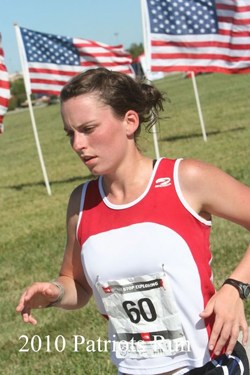
Army First Lt. Claire Heid is busier than you.
The military police officer — and executive officer of her unit — manages to fit in 120-mile training weeks while planning a September wedding and preparing for a December deployment to Afghanistan.
At 23, she’ll be the youngest starter at this year’s Badwater Ultramarathon in July in Death Valley, Calif.
And if she finishes, she’ll be the youngest female finisher in the race’s history.
[The youngest male finisher was 19-year-old Nickademus Hollon — 33:21:29 — in 2009. He also finished in 2010.]
Heid didn’t plan on tackling three huge life goals in six months, but when the opportunities arose, she didn’t back down.
“It is really busy, but at the same time, it’s also everything I’ve ever wanted. It’s just all happened at the same time,” Heid said. “I wanted to do Badwater for so long, and of course I want to get married.
“And deploying … I was handpicked for this job to deploy, so that’s an honor. It’s just all happening at once.”
The start
Heid got started in ultrarunning after an eye-opening experience at West Point in 2008. She wrote about it on her Badwater application:
In February 2008, I was a sophomore at the United States Military Academy at West Point. I was invited to try out to be sent to an elite 28-day military training program that had only been available for females to attend since 2000. Out of 800 cadets who … applied to attend the tryout, only 100 were selected for the tryout itself, three of those people being females. Only 20 would receive slots to the school. The tryout was an entire day of physical activity. With all the races I have done to date, nothing has been as difficult as that tryout. I was not selected to attend the training, but I looked at the people who did and noticed that they were endurance athletes: ultrarunners and triathletes predominantly.
“I didn’t get in,” she said. “And I was like, ‘No — that’s not acceptable to me.’ “
So she became a distance runner.
At age 20 — eight months after being turned down for the elite school — Claire finished the Bimblers Bluff 50KM in Connecticut. The following year, she finished her first 50-miler (JFK in Washington, D.C.) and in 2010 finished the Arkansas Traveler 100-miler with a time of 27:38:27.
In just three years, she’s gone from being a recreational athlete to a Badwater bib-holder.
She’s only run three 100-mile races, the minimum an applicant needs in order to be invited to the race, but she doesn’t feel her inexperience will hurt her.
“You see some names out there, like you see Dean Karnazes and you see people like Pam Reed and Marshall Ulrich,” she said. “You see those names on there, and they’re like legends. But I guess at the same time … everyone has to start somewhere. I know that I’m not going to be a contender to be one of the top elite athletes or somebody finishing toward the top of this race by any means. But even if I just finish … at some point, all those athletes — their goal was just to finish, too.”
She’s wisely chosen a crew captain with one Badwater start (he didn’t finish because of mononucleosis, Heid said) and two years of Badwater crewing experience. So while she — in the grand scheme of things — is an ultra newbie, her crew is not.
Being a better soldier
The other Badwater military runners we’ve profiled thus far — Mosi Smith, Tim Hardy and Mike Morton — have all talked about how they think their military service has made them better ultrarunners. Claire told me a little about how distance running has made her a better soldier.
“Being in good physical shape — and it’s not just marching through the mountains — like if something comes up and somebody gets hurt and you need to carry somebody out of there, then you need to make sure you can do it,” she said. “And you don’t know how far you’re going to have to go and you don’t know when you’re going to be able to stop, so just being able to push yourself to the limits of endurance — making sure that I was able to do that was essential to me.”
In a way, Heid’s Army experience has helped her as a runner, because it’s helped her plan. Being in charge of logistics for her unit’s deployment isn’t that far off from being in charge of getting five crew members, two crew vehicles and countless pounds of supplies to Death Valley.
“It doesn’t matter how well trained you are if you can’t get yourself there,” she said of preparing for deployment. “I guess it’s kind of the same with Badwater: It doesn’t matter how well trained you are if you don’t have your race crew set up, or you don’t know what you’re going to eat or drink or how often you need to do that. If you don’t know the logistics behind the race, then you’re not going to make it.”
Training
While logistics are her strong suit, Claire isn’t exactly slacking in the training department.
Most weekdays she runs eight miles in the morning, eight more miles with her unit and then four miles in the evening followed by an hour sweatfest in the sauna. Saturdays are for a 15- to 20-mile trail run and Sundays — always — are for church and yoga.
“There have definitely been weeks where I just feel like it’s taken a toll on my body and like maybe I’m pushing myself too hard,” she said. “With how many miles I’m running right now, I don’t have an issue with, like, cutting a day of mileage — like instead of running 20 a day, I cut it down to 10. I don’t want to get to the race and be worn down. If my body is saying, ‘You need to cut the mileage down today,’ I’ll cut the mileage down.”
One thing she doesn’t cut back on is her heat training. Heid is stationed at Joint Base Lewis-McChord in Tacoma, Wash., which even at its hottest is still at least 40 degrees cooler than Death Valley in July.
“Being in Washington,” she said, “it doesn’t get hotter than 75 degrees here — ever — and so it’s really hard to do any sort of heat training outside.”
To offset her geographical disadvantage, Heid spends an hour each day in the sauna, sweltering in temperatures between 180 and 200 degrees. She said she feels as if she’s acclimating well.
Motivation
Heid said she’s always had her eye on Badwater, but not because she’s chasing a buckle.
“I want to be that 23-year-old female that crosses the finish line, and people know that I’m inspired by something other than a belt buckle,” the then-platoon leader wrote in her application. “I want to run Badwater because I want to run the toughest race there is. I want to run Badwater because I carry the thought of the 43 soldiers that I lead with me, because they are the reason I started running ultramarathons.”
Team Red White & Blue
Claire is fundraising for the veteran support group Team Red White & Blue. Her donation page is here.
PT365 will be at Badwater July 16-18. Check back for updates on Mike Morton, Mosi Smith, Tim Hardy, Claire Heid and Hannah Roberts. Follow us on Twitter for live updates (@PT365)