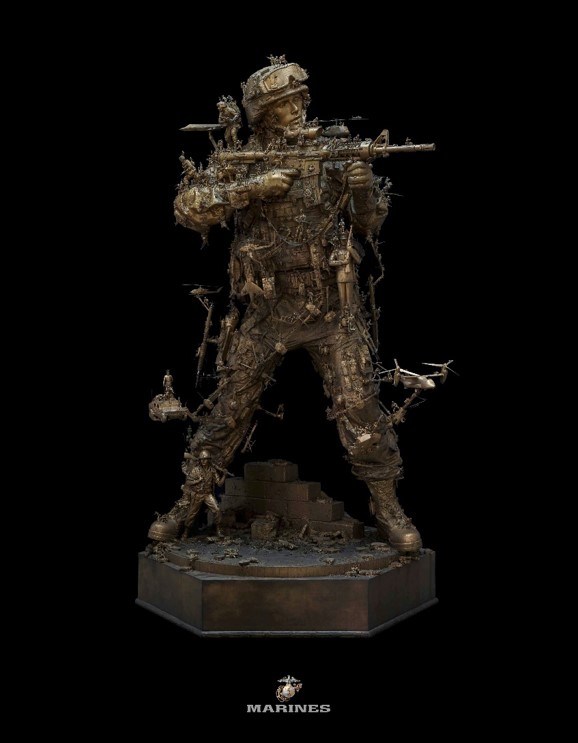
Three new statues at the National Museum of the Marine Corps reflect the themes of the Corps’ latest recruiting campaign: making Marines, winning battles and returning quality citizens to local communities.
“The mentality of a Marine is selflessness, camaraderie, brotherhood and kinship — all working together and fighting to the death for your fellow man,” Kris Kuksi, who created the sculptures, said at a Dec. 13 ceremony at the museum. “I wanted to capture the fighting spirit.”
Marine Corps Recruiting Command donated three sculptures to the museum: “At Their Core,” “Nation’s Call” and “Waged in Will.” Each statue is a visual representation of the “Battles Won” recruiting campaign, which began in March.
It took Kuksi about seven months to create the sculptures using toy soldiers, building blocks, model kits and 3-D printed accessories, a MCRC news release says.
“Kris really took the essence of the Marine Corps and materialized it through his imagination and into artwork,” Col. Terence Trenchard, MCRC chief of staff, said on Dec. 13. “Winning our nation’s battles is one of our promises as Marines, and it can be seen here — in a physical sense — as a long-carried tradition and culture.”