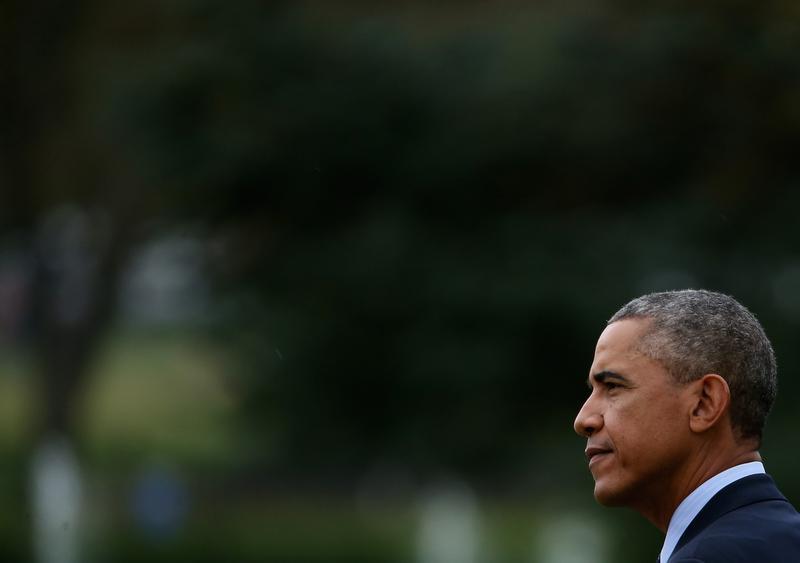
President Obama will be briefed Wednesday at the Pentagon by the Joint Chiefs of Staff and combatant commanders on operations to confront the Islamic State in the Middle East and contain the Ebola outbreak in West Africa, said Air Force Col. Ed Thomas, a spokesman for the chairman of the Joint Chiefs.
Obama and the military commanders are likely to examine whether the current U.S. strategy to combat the Islamic State using mainly air power is succeeding, said retired Army Lt. Gen. David Barno, a senior fellow with the Center for a New American Security think tank in Washington, D.C.
By now, it should be apparent what airstrikes can and cannot do, Barno said.
“They’ve been going on long enough and ISIS [the Islamic State in Iraq and al-Sham] has been relatively resilient enough to point out that airstrikes are not going to be a panacea,” said Barno, who commanded U.S. and allied troops in Afghanistan from 2003 to 2005. “They’re certainly not going to destroy ISIS by themselves. They can be an enabler for ground combat power to effectively fight ISIS but they’re not a substitute for ground combat power. I think, perhaps, not all that was completely apparent to all observers a month or two months ago.”
The discussion on Wednesday could lead to the deployment of more U.S. advisers and forward air controllers to Iraq and efforts to more closely coordinate airstrikes with Kurdish and Iraqi ground operations, said Barno, who does not expect the U.S. to make any major changes in its approach in Syria.
Another topic likely to come up is how the U.S. can protect Turkey, Barno said. Islamic State fighters are on the verge of overrunning Kobani, a Kurdish town on Syria’s border with Turkey. Barno said he expects the U.S. to share more intelligence with Turkey and provide the Turks with other assistance to help them defend their border against the Islamic State group.
“I don’t see at this point in time a likelihood — or even a need — for American advisers inside of Turkey, but I think we’ll do more to beef up our command structure in Turkey and make sure we maintain a very robust dialogue with them to help them see what ISIS is doing on their border and maybe help facilitate their operations,” Barno said.
One way the U.S. could increase the pressure on the Islamic State would be to train Iraqi, Kurdish and Syrian resistance forces to call in airstrikes, said retired Maj. Gen. James Poss, former Air Force assistant deputy chief of staff for intelligence, surveillance and reconnaissance.
“I think a limited number of coalition liaison personnel with these forces would go a long way to help in a close-air support battle,” said Poss, now a researcher at Mississippi State University.
Unmanned aircraft are able to fire a laser on a target to guide bombs from manned aircraft, but early U.S. operations in Afghanistan showed that having a joint terminal attack controller working with ground forces is much more effective.
“Both sides have their regular forces; both sides have U.S. equipment,” Poss said. “I’m sure the [Islamic State] guys learned very quickly not to put those big black flags on everything. Now, a lot of that looks the same from the air. That’s where that close coordination with a joint terminal attack controller on the ground can work with local forces so at least you can identify where your guys are — and, by process of elimination, where the bad guys are.”
At the moment, the U.S. needs to broaden its coalition and bring more resources to the fight, especially ground forces, said retired Adm. James Stavridis, former chief of U.S. European Command and supreme allied commander in Europe from 2009 to 2013.
“The Arab states can be very helpful; Turkey will be key, and pressure needs to be applied to NATO to get the rest of the alliance fully in the game — not only in Iraq, but in Syria as well,” said Stavridis, now dean of the Fletcher School of Law and Diplomacy at Tufts University.
For the medium term, the U.S. should focus on pressuring the Islamic State group on three fronts: the Kurdish peshmerga in the north, Iraqi security forces in the south and airstrikes in the west, Stavridis said in an email to Military Times.
The U.S. military should help cut off the Islamic State’s funding by attacking oil smuggling routes and supporting the CIA and Treasury Department’s efforts to disrupt the Islamic State’s finances, he added.
The ultimate goals are to train, support and equip the peshmerga and Iraqi security forces and the moderate Syrian resistance, Stavridis said, which will require placing advisers and trainers with these forces.
Defeating the Islamic State will also involve a decades-long stabilization, rebuilding and education effort to provide an alternative to joining the jihad.
“This is a long-term effort, and the conversation coming from the Pentagon will reflect that in very realistic terms,” Stavridis said. “In the end, of course, it will be the president who decides, based on the assessments and options with which he is presented — and it will not be a pretty picture.”