Post-9/11 veterans are sharply divided about whether the U.S. air campaign in Syria and Iraq is enough to defeat the terrorists or whether the U.S. needs to commit boots on the ground to destroy the Islamic State.
Joe Jones, a former Army combat engineer who deployed twice to Iraq, said he is willing to go back to stop the Islamic State from killing Iraqi civilians. Jones, who does not speak for the Army or the veteran community, blames the U.S. for withdrawing troops from Iraq in December 2011 and creating a power vacuum that was filled by the Islamic State, formerly known as the Islamic State of Iraq and al-Sham.
“I just got off of IRR [Individual Ready Reserve]; if I get the phone call, I’ll tell them you don’t even have to retrain me — just give me a carton of cigarettes every week; give me a case of beer, enough ammo and equipment to do what I got to do, I’ll take care of every single ISIS mother-sucker because I don’t believe the innocents should die,” said Jones, who left the Army as a specialist.
Jones made clear that he is not eager to kill Islamic State fighters; during his deployments to Iraq as a combat engineer, his goal was not to fill body bags.
“I was there to prevent soldiers from dying,” he said. “Every roadside bomb I found was a Humvee loaded with soldiers that I saved. I believe that if I go, every ISIS guy that I take down is a family of four that wants to freely practice their religion; that wants to freely live life and enjoy the life experience.”
Jones’ opinion is by no means held by everyone. Former Marine Capt. Matt Collins is opposed to sending conventional troops back to Iraq to fight the Islamic State.
“I don’t think it’s a good idea for us to put boots in the ground because the Iraqis don’t want us there,” Collins told Military Times. “I don’t think the American public wants boots on the ground. The Iraqis seem to think that ISIS is a CIA conspiracy — something that is contrived. The Shia of Iraq are understandably paranoid about us re-invading their country.”
Collins spent two years in the Pentagon as an Iraq specialist attached to the Joint Staff. The U.S. military’s current approach of using manned and unmanned aircraft to attack terrorist groups in Iraq and Syria and a small number of U.S. troops working with Iraqi and Kurdish forces is “the only acceptable strategy to the Iraqis,” he said.
The Shiites in power in Iraq are wary of U.S. intentions because they feel the U.S. government has not kept past promises to them, Collins said. And while Arab nations are helping the U.S. attack the Islamic State, an Iraqi Shiite government would view Arab troops in Iraq as occupiers.
However, Collins believes the Iraqis may ask for more direct U.S. military support if the Islamic State advances further.
“If they’re knocking on the door of Baghdad, they might be more amenable to us coming in — or there’s the possibility this could be the beginning of yet another civil war,” he said. “That’s the outcome that no one wants to happen.”
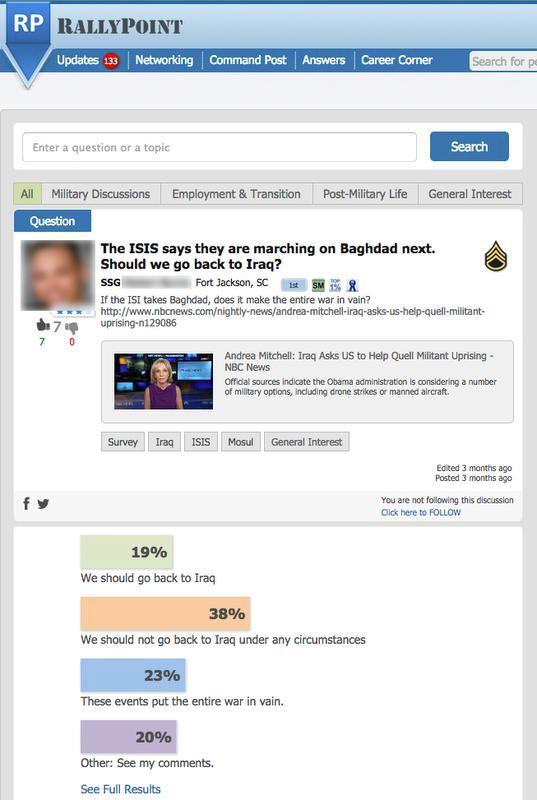
The debate over how far the U.S. should go to fight the Islamic State is playing out online. Yinon Weiss is founder of Rally Point, an online military community where hundreds of members are involved in various discussions about the U.S. military action in Iraq and now Syria, he said.
“On discussions about whether there is support for the air campaign that was recently started by the president, there is overwhelming support,” Weiss told Military Times. “In fact, most of the comments are in the nature of: ‘It’s about time,’ ‘We should have done this earlier,’ ‘I’m glad we’re finally doing something.’”
But Weiss said service members and veterans are more conflicted over whether the U.S. should send combat troops back to Iraq — a move that President Obama has said he will not do, yet a growing number of experts are saying is inevitable.
“While opinions are complicated, there’s a very strong indication that there’s a desire not to put boots on the ground back in Iraq — and I imagine Syria as well; that question hasn’t been asked,” he said.
In a recent unscientific survey of Rally Point members, 38 percent of respondents said they were opposed to sending troops back to Iraq under any circumstances, Weiss said.
“Most veterans we see on here are very supportive of boots on the ground,” he said. “I would say with service members, it is much more mixed, in that many question whether the U.S. military has the endurance to potentially open up a new ground front … whether it’s really in the military’s best interest — or even the U.S. best interest — to reignite a broader land war. But then there’s also those who were in Iraq. There’s this kind of notion of, ‘We don’t want our previous gains and losses to be in vain.’”
Kris, a first lieutenant in the Army National Guard who asked to be identified by first name only, became so despondent by the rise of the Islamic State that he posted a White House petition on Sept. 2 that calls on the U.S. to use “any means necessary” to destroy the terrorist organization. But the petition had only received nine signatures by deadline.
During the 26 months that he spent in Iraq, Kris became friends with Iraqi Kurds, he said in an email to Military Times. Now, the Kurdish Peshmerga forces are having a hard time fighting the Islamic State and the Iraqi army has proved that it is not up to defeating the group.
“This means it’s time for the U.S. military to do what it does best and take the fight to the enemy,” he wrote in the email. “Boots on the ground, fighting as we have trained and trained for. Send in the infantry, artillery, armor, aviation, and whatever else it takes to keep one more American family from seeing their loved one decapitated on YouTube.”