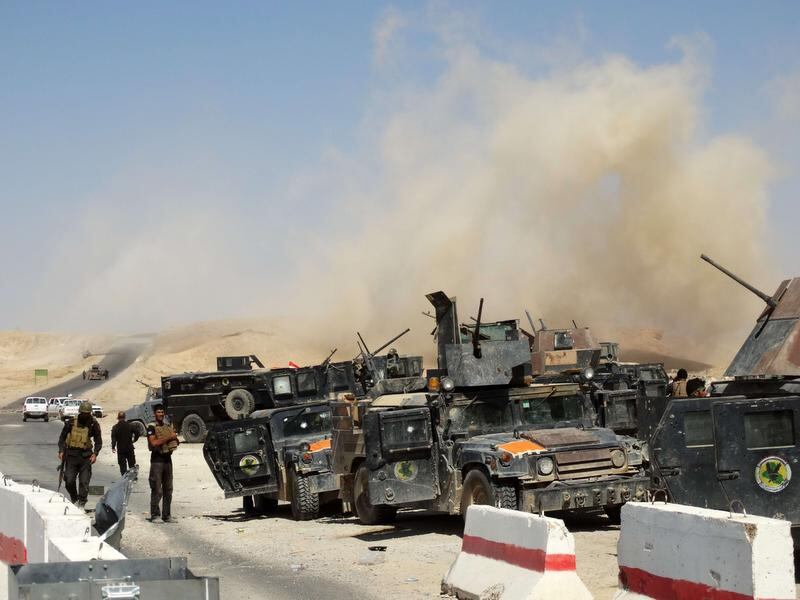
The U.S. military is coordinating some airstrikes with Sunni tribal militias on the ground in Iraq's Anbar Province after Islamic State militants began to build up forces near the Haditha Dam, a Pentagon official said Monday.
The strikes that began Saturday marked an expansion of the four-week-old U.S. bombing campaign in Iraq by targeting IS forces for the first time in the western part of the country, where the militants have held territory for months. Until now, U.S. airstrikes were limited to Iraq's northern provinces and the Kurdish border region.
The timing of the strikes was driven in part by intelligence showing the miliants amassing forces in the area around the Haditha dam, a large facility that provides electricity and water to millions of Iraqis in the Euphrates River Valley.
"We had seen the enemy moving heavier weapons into that area, so it became clear to us that they were potentially planning to increase pressure on the Haditha dam area," said Army Col. Steve Warren, a Pentagon spokesman.
The Islamic State was "moving artillery pieces into positions closer around the dam specifically as well as … 'technical' vehicles, or these armed trucks that they like to use," Warren said Monday.
The timing of the expanded bombing mission into western Iraq also is being driven by the growing reliability of U.S. allies on the ground. In recent weeks, both official Iraqi security forces and irregular Sunni tribal forces in the area have gained strength, Warren said.
"Friendly forces, Iraqi and Kurdish forces, had been continuing to build up their combat power around the Haditha dam area and the time was right for a counterattack," Warren said.
"Our coordination is primarily is with the Iraq security forces, the regular Iraq military along with the pesh merga," he said, using the local term for the Kurdish military forces in the north.
"There are a number of local tribes that are also supporting this operation," Warren added. "A lot of local tribes have local militias that are fairly well armed."
The Sunni tribes in Anbar Province were central to the success of the U.S. troop surge in Iraq in 2007 because they turned against the extremists then known as al-Qaida in Iraq and forged an alliance with U.S. Marines.
Pentagon officials say there are no U.S. troops involved in ground combat in Iraq and airstrikes are coordinated with Iraqis through two joint operations centers in Baghdad and Irbil.
Warren said U.S. airstrikes are now limiting the ability of Islamic State forces to move freely in the Iraqi territory they control.
They are "beginning realize that American air power is lethal and if they move, they will be seen and destroyed," Warren said. "Certainly this will impact [the militants'] ability to move on the battlefield."
Andrew Tilghman is the executive editor for Military Times. He is a former Military Times Pentagon reporter and served as a Middle East correspondent for the Stars and Stripes. Before covering the military, he worked as a reporter for the Houston Chronicle in Texas, the Albany Times Union in New York and The Associated Press in Milwaukee.