Irma recovery could require 11M meals, 24,000 tarps and more
By Gary Fineout, The Associated Press
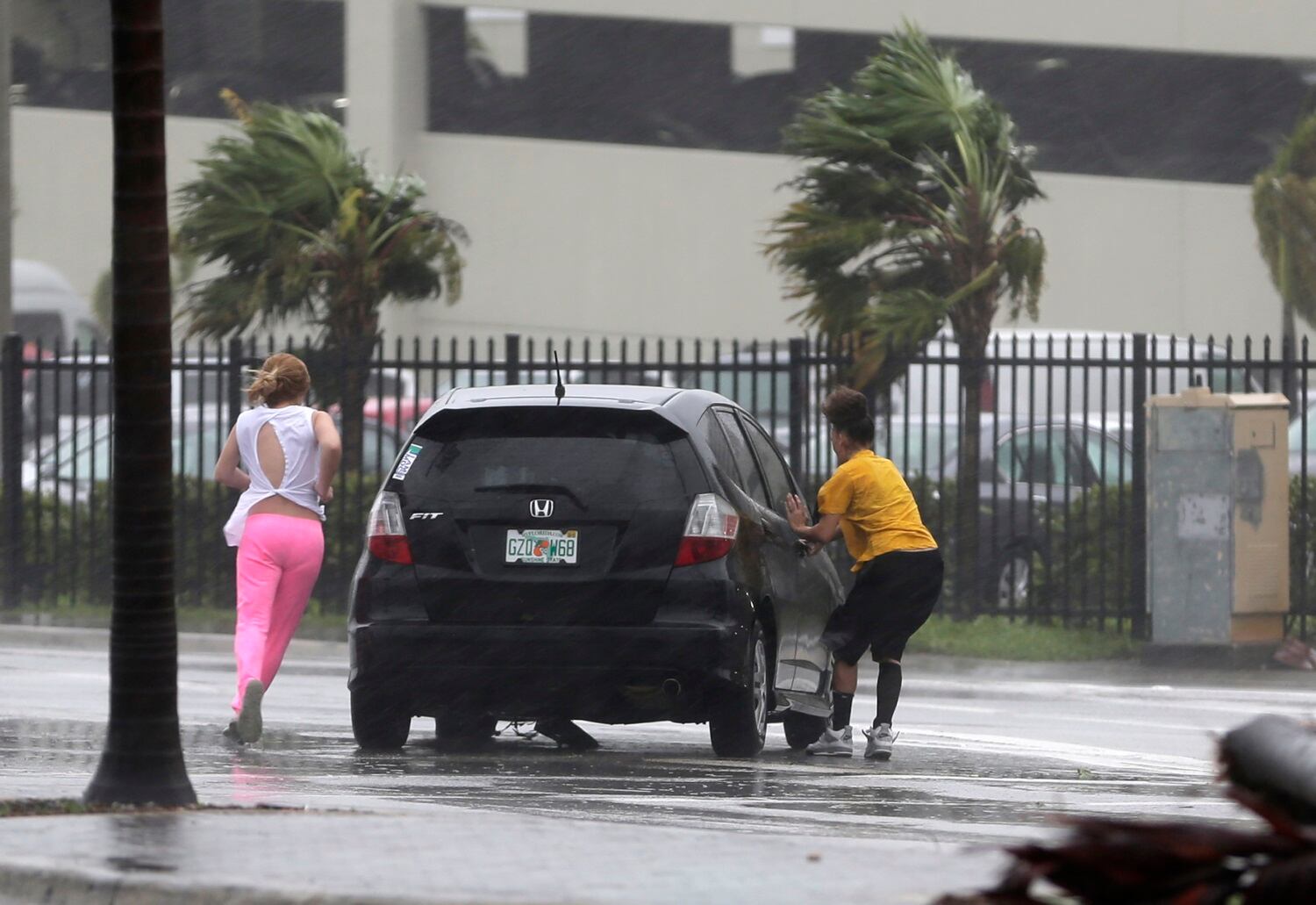
Stranded motorists try to get back in their car after a breakdown as Hurricane Irma bears down on the Florida Keys, Sunday, Sept. 10, 2017, in Hialeah, Fla. Wind gusts of 82 mph were reported in Miami. (Alan Diaz/AP)
7,000 National Guardsmen dispatched to more than 400 shelters across Florida
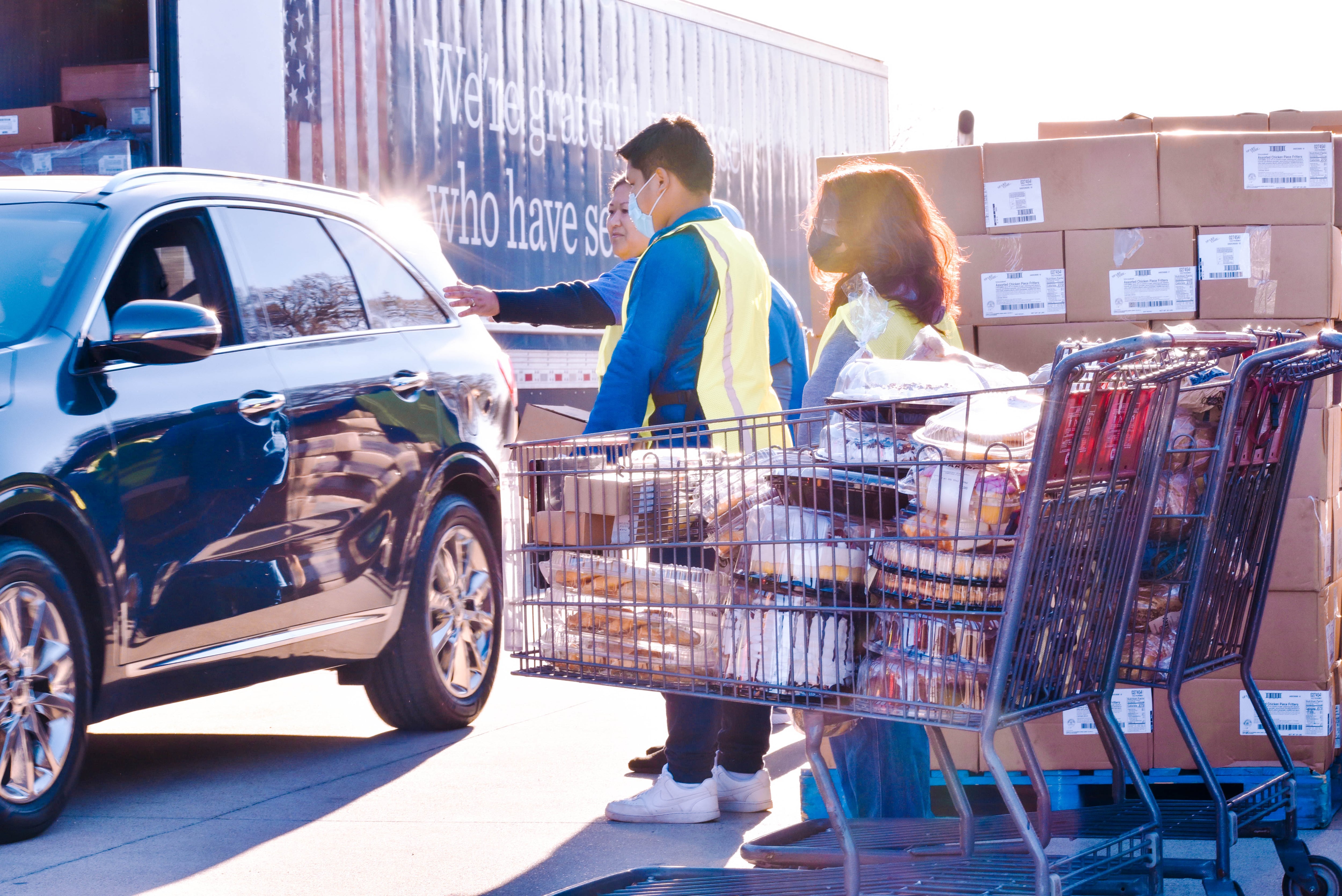
With the arrival of what is potentially one of the most devastating storms to ever hit Florida, officials have set aside 3.2 million liters (0.85 million gallons) of water, filled 67 trailers with meals, and amassed 24,000 tarps. They also have asked the federal government to kick in 11 million meals and millions more liters (gallons) of water, plus nearly 700 cases of baby supplies.
When it is finally safe for emergency officials to fan out across the peninsula, they will find out whether that is enough.
Image 0 of 14
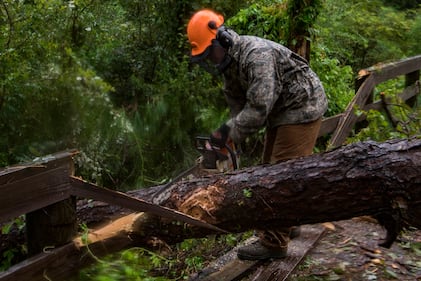
Senior Airman Justin Benito, 23rd Civil Engineer Squadron heavy equipment operator, uses a chainsaw to cut a fallen tree’s trunk on Sept. 11, 2017, at Moody Air Force Base, Ga. Moody’s ride-out team consisted of approximately 80 airmen who were tasked with immediately responding to mission-inhibiting damage caused by Hurricane Irma. (Airman 1st Class Daniel Snider/Air Force)
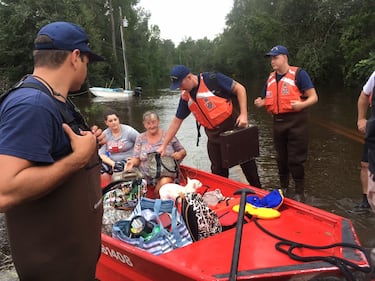
Coast Guard Flood Punt Teams conduct rescue operations in Jacksonville, Fla., Sept. 11, 2017. The Coast Guard has deployed assets and resources from across the country to assist in rescue operations for Hurricane Irma. (U.S. Coast Guard)
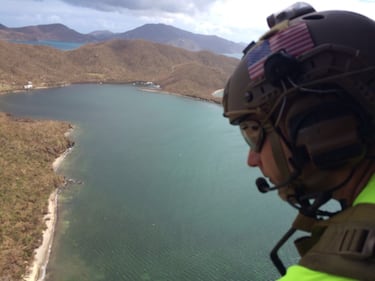
Five airmen from the Kentucky Air National Guard’s 123rd Special Tactics Squadron conduct search-and-rescue missions on St. John, U.S. Virgin Islands, Sept. 9, 2017, in conjunction with the Kentucky Army National Guard’s 63rd Theater Aviation Brigade. The airmen have controlled multiple helicopter landing zones and evacuated numerous victims by hoisting them to Kentucky Army Guard UH-60 Black Hawk helicopters for evacuation. (Air National Guard)
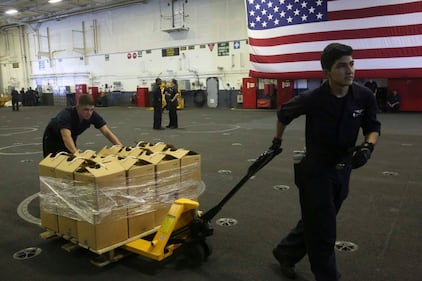
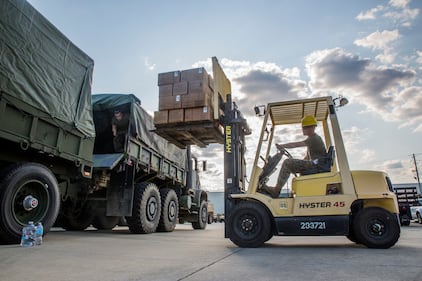
Sailors aboard the Nimitz-Class aircraft carrier USS Abraham Lincoln (CVN 72) move pallets of water on Sept. 11, 2017, in preparation to support those affected by Hurricane Irma.
(Aviation Boatswain’s Mate (Equipment) 2nd Class Lauren D. Smith/Navy)
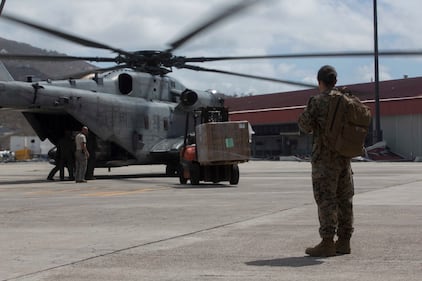
U.S. Marine Corps 1st Lt. Paloma D. Perezurena, a logistics officer with the 26th Marine Expeditionary Unit (MEU), observes U.S. Marines and U.S. Airmen unload humanitarian resources from a CH-53 Super Stallion helicopter with the 26th MEU, to support relief efforts in St. Thomas, U.S. Virgin Islands, Sep. 10, 2017. (Lance Cpl. Santino D. Martinez/Marine Corps)
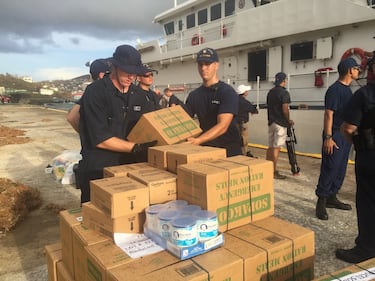
Coast Guard Cutter Joseph Tezanos crewmembers load a pallet of emergency ration meals for emergency responders to pass out to the residence of St. Thomas, U.S. Virgin Island, Sept. 10, 2017, after Hurricane Irma severely damaged the island. (Chief Petty Officer Crystalynn Kneen/Coast Guard)
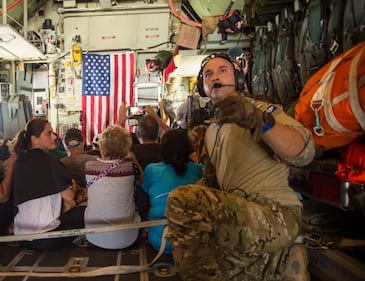
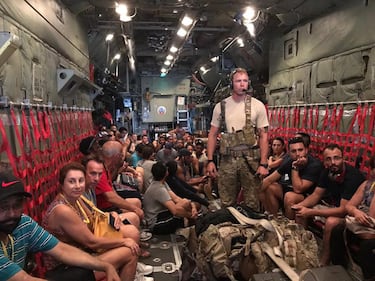
Master Sgt. James Brucculeri, loadmaster with the 103rd Rescue Squadron, ushers evacuees onto a HC-130 on St. Maarten headed to San Juan, Puerto Rico, on Sept. 10, 2017. (Staff Sgt. Erin Mills/Air Force)
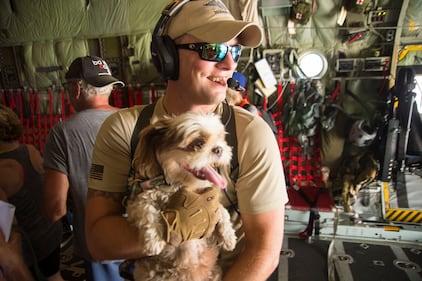
Capt. William Hall, HC-130 pilot with the 102nd Rescue Squadron, helps bring an evacuee's service dog on board an HC-130 headed to San Juan, Puerto Rico, on Sept. 10, 2017. (Staff Sgt. Erin Mills/Air Force)
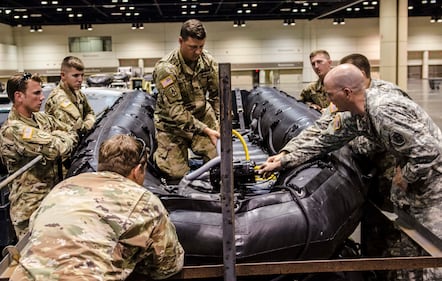
Soldiers with the Florida National Guard’s Chemical Biological Radiological Nuclear Emergency Response Force-Package inflate a zodiac boat used in the rescue operations of civilians during disasters such as Hurricane Irma. The CERF-P joins the Florida Fish and Wildlife Conservation Commission and the New York State Division of Homeland Security & Emergency Services and Urban Search and Rescue at a staging in Orlando while they await reconnaissance and rescue missions. (Staff Sgt. Carmen Fleischmann/National Guard)
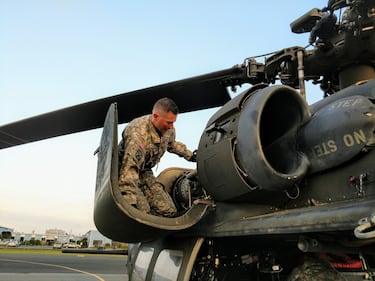
Army Chief Warrant Officer 2 Kevin Colby conducts preflight inspections on his UH-60 Black Hawk helicopter as aircrews of the New York Army National Guard’s Company B, 3rd Battalion, 142nd Aviation Regiment prepare for takeoff and deployment from Long Island MacArthur Airport, Islip, N.Y., to Florida in support of the Guard response to Hurricane Irma on Sept. 11, 2017. Ten UH-60 Blackhawk helicopters and 55 aircrew members and maintainers deployed from three flight facilities across the state to support the Florida Army National Guard. (Capt. Mark Getman/New York National Guard)
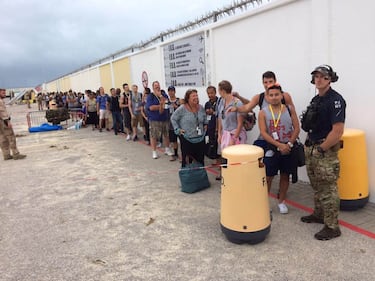
Members of the New York Air National Guard's 106th Rescue Wing assist in the evacuation of stranded American citizens from Princess Juliana International Airport in St. Maarten, Sept. 8, 2017. The rescue wing, staging out of San Juan, Puerto Rico with the Puerto Rica Air National Guard’s 156th Airlift Wing, provided rescue support to those requiring urgent medical care following the devastation of Hurricane Irma in the Caribbean. The coordinated effort between the Department of State and Department of Defense evacuated 1,172 Americans and 35 other foreign nationals from St. Maarten with the 106th prior to the arrival of Hurricane Jose. (Air National Guard photos courtesy of the 106th Rescue Wing)
The New York National Guard's 106th Rescue Wing assists in airlifting U.S. citizens stranded in St. Martin on Sept. 9, 2017, after Hurricane Irma devastated the island, with HC-130 King aircrews, maintainers, rescue teams and other Airmen from New York, Puerto Rico and Kentucky to name a few. (Maj. Sean Boughal/National Guard)
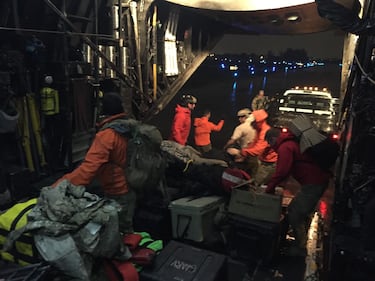
U.S. Air Force Guardian Angel pararescuemen from the 121st Rescue Squadron, Alaska Air National Guard, unload their equipment from an MC130P Combat Shadow aircraft assigned with the 129th Rescue Wing, California Air National Guard at Miami Opa Locka Executive Airport, Fla., as Hurricane Irma approaches Sept. 9, 2017. The Guardian Angel team are prepositioning themselves and staging equipment 20 miles outside of Miami in a safety bunker rated for a Category 5 hurricane in order to have immediate capability once the storm passes to begin personnel recovery operations. (Tech. Sgt. Joseph Prouse/Air National Guard)
Marines from 3rd Force Reconnaissance Company, 4th Marine Division, Marine Forces Reserve, load a spare tire onto an MTVR 7-ton truck at the Alabama Army National Guard Fort Whiting Armory in Mobile, Ala., Sept. 9, 2017, in preparation of rescue missions following Hurricane Irma. (Lance Cpl. Niles Lee/Marine Corps)
Hurricane Irma made landfall in the Florida Keys on Sunday morning with top sustained winds of 130 mph (215 kph). While the projected track showed Irma raking the state’s Gulf Coast, forecasters warned that the entire Florida peninsula — including the Miami metropolitan area of 6 million people — was in extreme danger from the monstrous storm, almost 400 miles (640 kilometers) wide. Nearly 7 million people in the Southeast were warned to get out of the storm’s path, including 6.4 million in Florida alone.
A weary Gov. Rick Scott, who has flown across the state during the past five days sounding the alarm bell ahead of landfall, acknowledged that it won’t be easy for residents in the days ahead. Florida has long dealt with hurricanes, including a stretch of eight hurricanes in two years while Jeb Bush was governor, but Irma’s wide reach has proved daunting.
“I don’t think anybody alive today in this state has ever seen anything like this,” Scott said at the state’s emergency operations center when the first parts of the storm started to cross into the Florida Keys.
More than 1 million residents had already lost power by Sunday morning, and it could be days before officials can provide food and water to those struggling in the aftermath of the powerful storm.
Florida has already spent $77 million ahead of Irma’s arrival. Scott called up 7,000 National Guardsmen who have been sent across the state, including dispatching them to some of the more than 400 shelters that have been set up.
Meanwhile, search-and-rescue teams located in Orlando and other staging areas were waiting out the storm until it was safe enough to go out and assess the extent of the damage and injuries. One of the teams was preparing to fly into Key West, directly in the path of the storm.
The challenges in the immediate aftermath of the storm will be many: Restoring across the state, removing debris from roads, dealing with possible fuel shortages, and making sure nursing home and hospital patients who were evacuated can safely return. State officials are also fearful the massive rain that was soaking the state could also lead to flash floods.
Scott said that he knows many Floridians want to resume their normal lives as soon as possible. But he acknowledged that may not happen soon.
“Florida will get through this,” he said. “You’ve got to be patient.”