U.S. Air Force Basic Military Training is continuing its transformation with the goal of becoming more realistic as officials plan to build two training ranges with mock runways and real aircraft this year at select bases.
In an effort to create an identity more tied to the force’s mission with the DOGS understanding — defend, operate and generate — officials will create an immersive training environment to create an “Airmindedness” attitude in every airman, according to Second Air Force Commander Maj. Gen. Wolfe Davidson.
“By progressing training from the drill pad to a simulated airfield, we give trainees immediate, hands-on context for their role in generating airpower,” Davidson said in a statement to Military Times.
This new curriculum and containerized training is part of an overall endeavor from Air Force officials to transform BMT, referred to as BMT Next.
An early step in this process was BMT 2.0 from last October, which placed an emphasis on more physical fitness training, and now BMT 3.0, which will include the training ranges.
The alterations to BMT will also incorporate a new training program for the military training instructors to boost their skills set to teach and mentor in the new environment, Davidson said.
Rather than allowing airmen to find their core identity solely through a specialized career training, this BMT transformation propels them to find it through a shared operation experience before beginning technical school.
“This transformation ties their identity more closely to the Air Force mission to fly, fight, and win, and better acclimatizes them to what they should expect when they are tasked to support an Air Expeditionary Wing — the Air Force Unit of Action,” Davidson said.
BMT 3.0 represents an update in the force’s training philosophy, which includes a new baseline for graduates to earn their airman title, he said.
According to Davidson, trainees must demonstrate physical readiness for military service demands; a foundational competency essential for success, like teamwork, accountability and a warrior ethos; and an understanding of their role in the fight.
“Instead of learning individual tasks, they are learning how their actions contribute to defending, operating, generating, and sustaining the mission in a contested environment,” Davidson said.
Trainees are expected to utilize basic concepts of airfield operations learned on the ranges to better work as a team with improved communication skills, solving increasingly more challenging scenarios under different stress levels.
This project is not meant to teach trainees technical tasks, like aircraft maintenance or airfield repair, as those are developed at technical or follow-on training, but it is set out to help them gain a better understanding of airfield operations and mission generation.
The first training range will be housed at Joint Base San Antonio-Lackland, recapitalizing on an existing physical training pad behind the legacy dorms, Davidson said, in order to not lose training time.
“Our partnership with the 502d Air Base Wing has allowed us to put this build on an expedited timeline, reflecting the enthusiasm and need for this initiative,” Davidson continued.
The range will initially be slightly larger than a football field, but trainees can expect it to triple in size eventually.
The BMT Next initiative is phased, beginning with mobile, containerized training stations on the Air Base Training Range.
Next, officials will build a dedicated expeditionary airfield at the Pacer Forge site, meant to simulate a forward-deployed environment focused on applying the DOGS concept.
The second training range, dubbed the Forward Air Base Training Range, will be on the Pacer Forge site on Joint Base San Antonio-Chapman Training Annex.
Pacer Forge, which began in late 2022, is a military deployment exercise during the sixth week of BMT.
The building of these training ranges produces a “Crawl, Walk, Run” training progression, per Davidson, with foundational lessons as the “crawl” and the initial training on the new ranges as the “walk” to practice and assess skills in a controlled setting.
The trainees will then arrive at Pacer Forge with a baseline understanding for the “run” portion, which is a multi-day validation exercise where trainees must apply those skills under sustained, simulated stress.
The final phase will be a larger, permanent version of the Air Base Training Range at JBSA-Lackland with four mock concrete runways, which will replace the first phase airfield.
It will include four identically equipped training zones, allowing multiple groups to train simultaneously and perform maintenance without disrupting the training schedule.
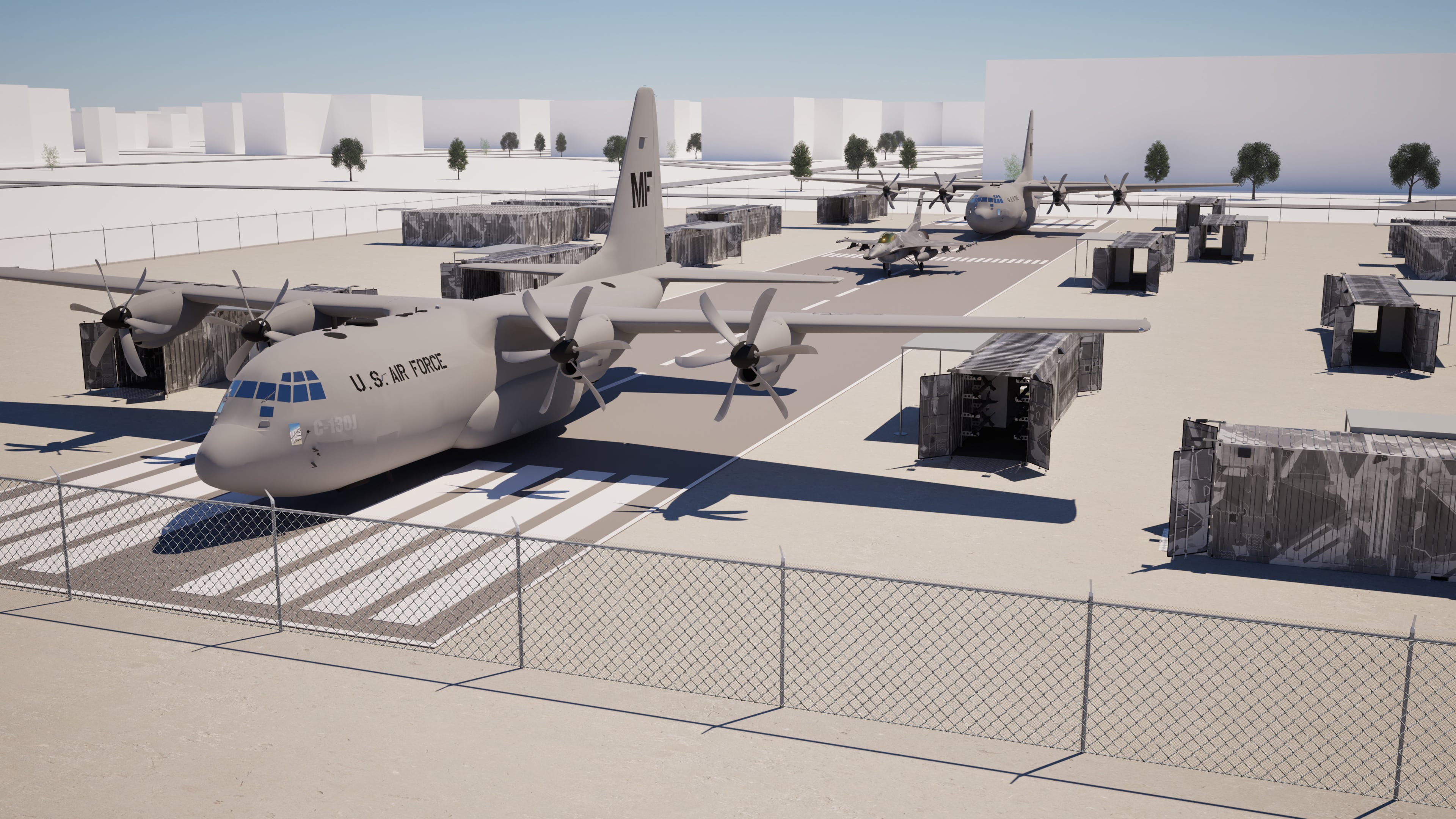
The Air Base Training Range will have 16 containerized training stations, with two for each of the eight airfield tasks: arming fighter aircraft, refueling, casualty transfer and evacuation, cargo loading, post-attack runway assessment and repair, aircraft marshaling, aircraft familiarization and airbase entry control.
Real, historic aircraft will be featured in the ranges to allow for authentic, hands-on hardware in a cost-effective way, said Davidson.
The initial Air Base Training Range will spotlight an F-16 Fighting Falcon and C-130 Hercules, which are non-flying aircraft previously used for maintenance training.
But, as the initiative progresses, decisions for the Forward Air Base and the final Air Base Training range aircrafts may change.
According to Davidson, in April 2026, the initial training device on the Air Base Training Range will be established, with the eight planned containerized training devices to be operational by fall 2026.
By October 2026, trainees can expect the first expeditionary airfield at the Pacer Forge site to be ready for initial training, but the second expeditionary airfield is planned for the site in late 2027.
The final, permanent Air Base Training Range is expected no earlier than 2031 as it is still in the planning phase, but it is expected to be a Milcon project.
This $30 million investment was spread across the budget for fiscal years 2025 and 2026, with the longer-term plan for the bases’ permanency expected to cost around $50 to $75 million, which officials will submit in a Future Years Program Objective Memorandum.
“This entire effort is a direct investment in the readiness and lethality of our force. We are creating the foundational ‘Airmindedness’ and warrior ethos in our newest Airmen to ensure we remain the world’s most capable Air Force,” Davidson said.
Cristina Stassis is a reporter covering stories surrounding the defense industry, national security, military/veteran affairs and more. She previously worked as an editorial fellow for Defense News in 2024 where she assisted the newsroom in breaking news across Sightline Media Group.