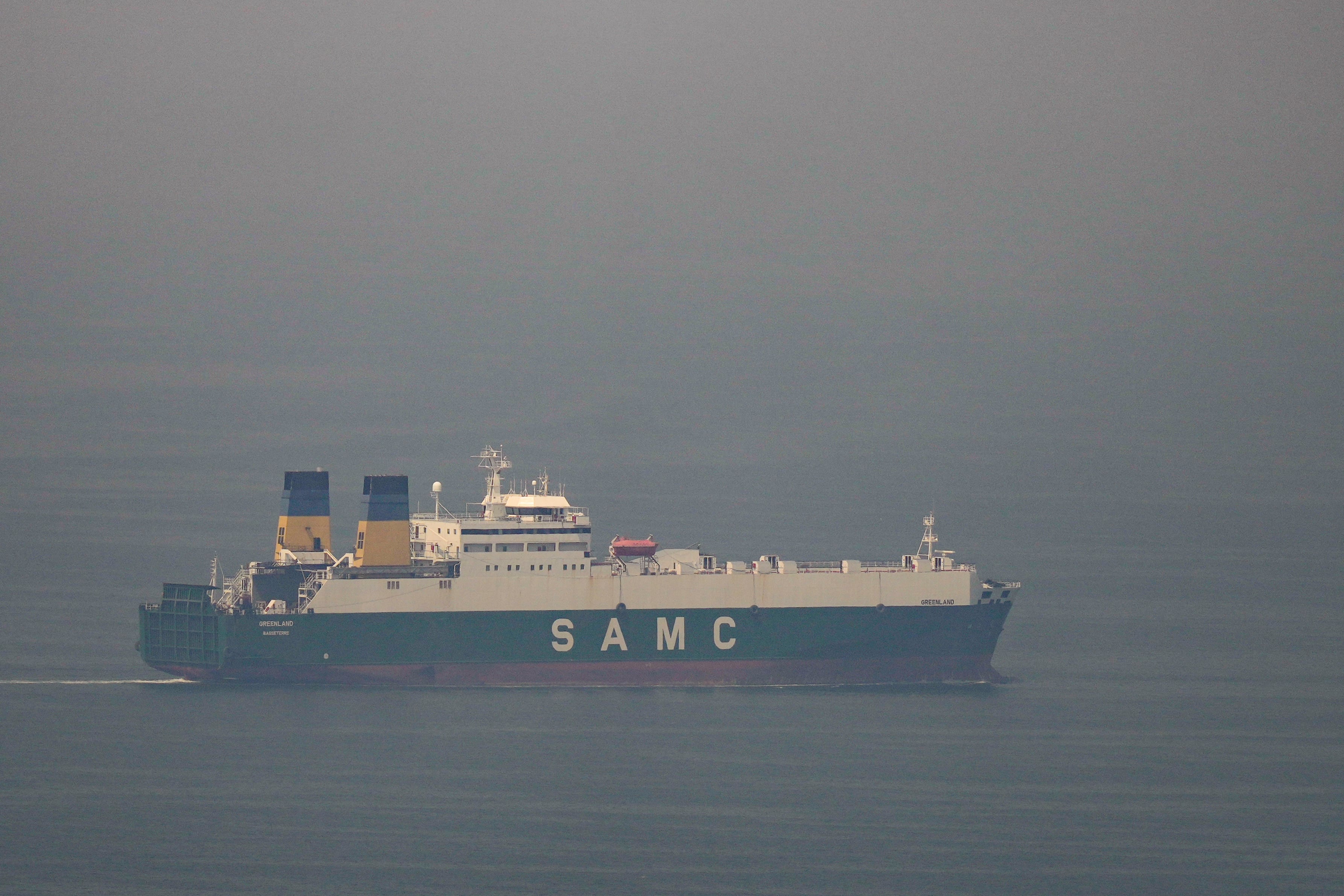
CAIRO — President Donald Trump said Sunday that he has demanded about seven countries send warships to keep the Strait of Hormuz open, but his appeals have brought no commitments as oil prices soar during the Iran war.
The president declined to name the countries heavily reliant on Middle East crude that the administration is negotiating with to join a coalition to police the waterway where about one-fifth of the world’s traded oil normally flows.
“I’m demanding that these countries come in and protect their own territory, because it is their own territory,” Trump said about the strait, claiming the shipping channel is not something the United States needs because of its own access to oil. Trump spoke while answering reporters’ questions as he flew back to Washington from Florida aboard Air Force One.
Trump said China gets about 90% of its oil from the strait, while the U.S. gets a minimal amount. He declined to discuss whether China will join the coalition.
“It would be nice to have other countries police that with us, and we’ll help. We’ll work with them,” Trump said. Previously, he has appealed to China, France, Japan, South Korea and Britain.
Iran’s Foreign Minister Abbas Araghchi earlier told CBS that Tehran has been “approached by a number of countries” seeking safe passage for their vessels, “and this is up to our military to decide.” He said a group of vessels from “different countries” had been allowed to pass, without providing details.
Iran has said the strait is open to all except the United States and its allies.
Araghchi added that “we don’t see any reason why we should talk with Americans” about finding a way to end the war, noting that Israel and the U.S. started the fighting with coordinated attacks on Feb. 28 during indirect U.S.-Iran talks on Iran’s nuclear program. He also said Tehran had “no plan to recover” the enriched uranium that is under rubble following U.S. and Israeli attacks last year.
Countries are cautious after Trump’s call
U.S. Energy Secretary Chris Wright told NBC earlier Sunday that he has been “in dialogue” with some of the countries Trump had mentioned previously, and said he expected China “will be a constructive partner” in reopening the strait.
But countries made no promises.
Britain said Prime Minister Keir Starmer on Sunday discussed with Trump the importance of reopening the strait “to end the disruption to global shipping,” and spoke with Canada’s prime minister about it separately.
Aboard Air Force One, Trump specifically named Starmer, who he said initially declined to put British aircraft carriers “into harm’s way.”
“Whether we get support or not, but I can say this, and I said to them: We will remember,” Trump said.
A spokesperson for China’s embassy to the U.S., Liu Pengyu, said previously that “all parties have the responsibility to ensure stable and unimpeded energy supply” and that China would “strengthen communication with relevant parties” for de-escalation.
South Korea’s Foreign Ministry said it “takes note” of Trump’s call and that it “will closely coordinate and carefully review” the situation with the U.S.
Expectations are high that Trump will ask Japan directly when Prime Minister Sanae Takaichi meets him on Thursday at the White House.
France previously said it is working with countries — President Emmanuel Macron mentioned partners in Europe, India and Asia — on a possible international mission to escort ships through the strait but has stressed it must be when “the circumstances permit,” when fighting has subsided.
Foreign Minister Johann Wadephul of Germany, which was not mentioned in Trump’s call, told ARD television: “Will we soon be an active part of this conflict? No.”
Meanwhile, emergency oil stocks “will soon start flowing to global markets,” the International Energy Agency said Sunday, describing the collective action to lower prices “by far the largest ever.”
It updated last week’s announcement of 400 million barrels to nearly 412 million. Asian member countries plan to release stocks “immediately,” and reserves from Europe and the Americas will be released “from the end of March.”
Trump didn’t directly answer whether his administration is talking about selling oil futures as a way to cap surging oil prices.
“The prices are going to come tumbling down as soon as it’s over. And it’s going to be over pretty quickly,” he told reporters.