From the Western Plains of the U.S., the beaches of Europe to the Pusan Perimeter, Buffalo Soldiers have played an integral part of U.S. military history.
Now, the Army is saying goodbye to one of the cavalry units whose lineage draws a straight line to the original Buffalo Soldiers.
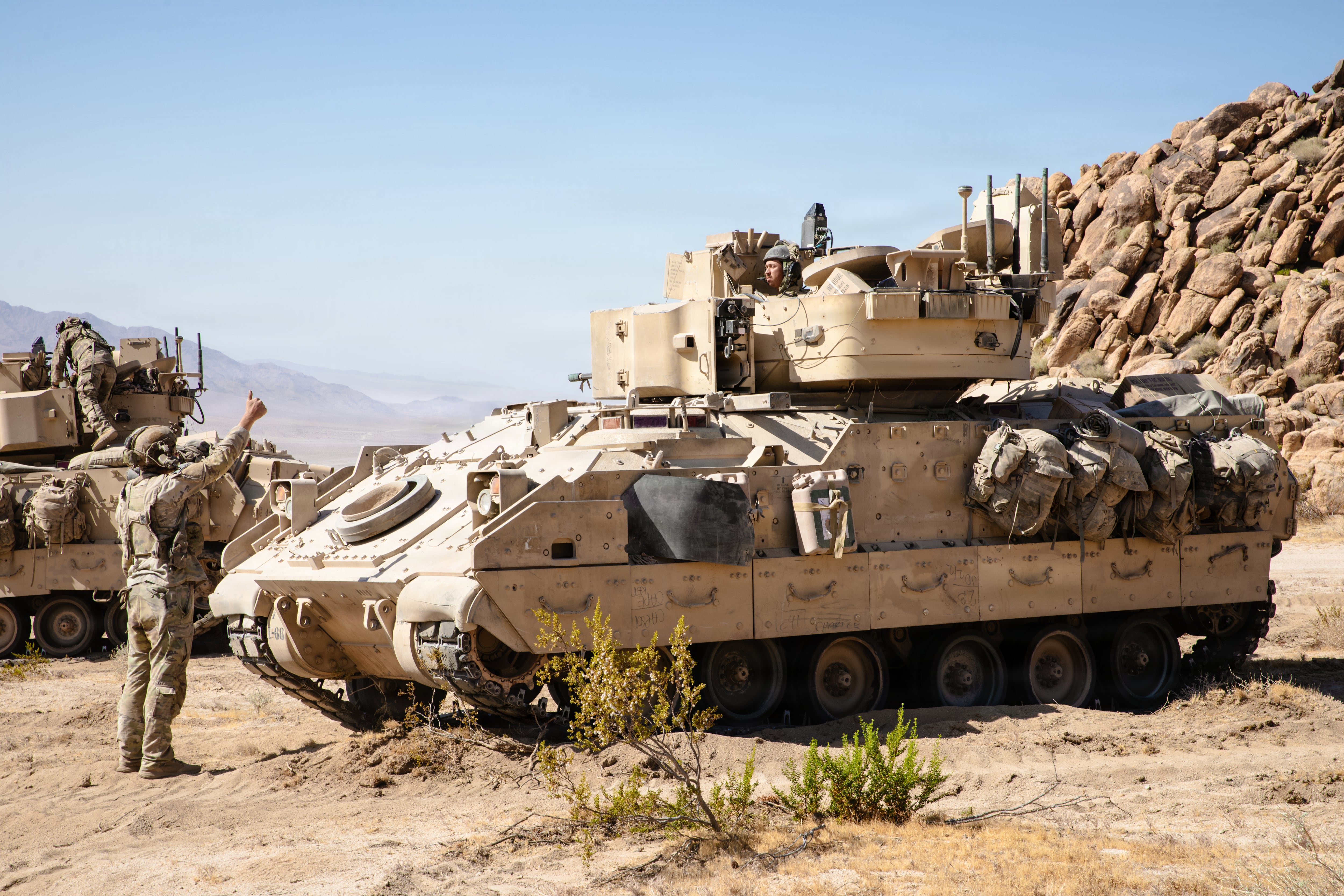
On Sunday, soldiers assigned to the 4th Squadron, 10th Cavalry Regiment, 3rd Armored Brigade Combat Team, 4th Infantry Division gathered to honor the squadron’s 160-year legacy during Project Convergence-Capstone 6 at Fort Irwin, California, according to a recent release.
Conducting a final formation before its deactivation on July 29, soldiers of the 4th Squadron, 10th Cavalry Regiment assembled to mark and honor the renowned Army unit.
While African Americans have fought in every major U.S. war since the nation’s inception, Black U.S. Regular Army units were not created until 1866 when, as part of a Army reorganization following the Civil War, Congress created six segregated Regular Army regiments of African American soldiers: the 9th and 10th cavalry regiments; and the 38th, 39th, 40th and 41st infantry regiments.
Three years later, the infantry regiments were condensed into four and redesignated as the 9th and 10th Cavalry and the 24th and 25th Infantry.
The newly established units were tasked with protecting frontier settlers, escorting wagon trains and securing transportation routes across the frontier, according to the release.
The nickname “Buffalo Soldiers” originated during the 10th Cavalry’s initial service in the Frontier Army during campaigns against Native American tribes.
While there are differing theories regarding the origin of the nickname, according to the National Museum of African American History and Culture, “One is that the Plains Indians who fought the Buffalo Soldiers thought that their dark, curly hair resembled the fur of the buffalo. Another is that their bravery and ferocity in battle reminded the Indians of the way buffalo fought.”
Regardless, the soldiers considered the name high praise, with an image of a buffalo becoming part of the 10th Cavalry’s regimental crest, according to the museum. Eventually, the name was extended to denote all troops in the four Black cavalry and infantry regiments.
Throughout the 19th century, American aspirations of “Manifest Destiny” were largely aided by the practical, on-the-ground support of Buffalo Soldiers who protected communities, escorted mail routes, built roads and safeguarded critical infrastructure, according to the release. Eighteen Buffalo Soldiers received the Medal of Honor during the Indian Wars from roughly the 1860s to 1890.
From its creation in 1866, Buffalo Soldiers fought in the Spanish-American War, Philippine-American War, Mexican Punitive Expedition, World War II and the Korean War.
Notable U.S. Army officers who led Buffalo Soldiers include Benjamin H. Grierson; Ranald S. Mackenzie; John J. Pershing; Henry O. Flipper, the first Black graduate of West Point; and Charles Young, the third Black graduate of West Point and the first African American promoted to the rank of colonel.
The oldest Buffalo Soldier, Mark Matthews, died on Sept. 6, 2005, at the age of 111. He is interred at Arlington National Cemetery.
Now, according to the release, the deactivation of 4-10 Cav “reflects the Army’s broader transformation of its force structure to meet the demands of future large-scale combat operations.”
As emerging capabilities, including unmanned systems and electronic warfare, enhance battlefield effectiveness, the Army is sunsetting the 4-10 to modernize its force structure.
“Today we honor 160 years of service, sacrifice, and excellence that began with the very first Buffalo Soldiers and continued through every Trooper that followed in their footsteps,” said Lt. Col. Shawn Scott, commander of 4th Squadron, 10th Cavalry Regiment.
“As the squadron colors are cased today on the 160th birthday of the regiment, we remember the courage, professionalism and selfless service of all those Black Jack Troopers who came before us. While this chapter comes to a close, the values and traditions of the Buffalo Soldiers will continue to live on in every Trooper who served in this extraordinary unit. READY AND FORWARD!” Scott concluded.
Claire Barrett is an editor and military history correspondent for Military Times. She is also a World War II researcher with an unparalleled affinity for Sir Winston Churchill and Michigan football.