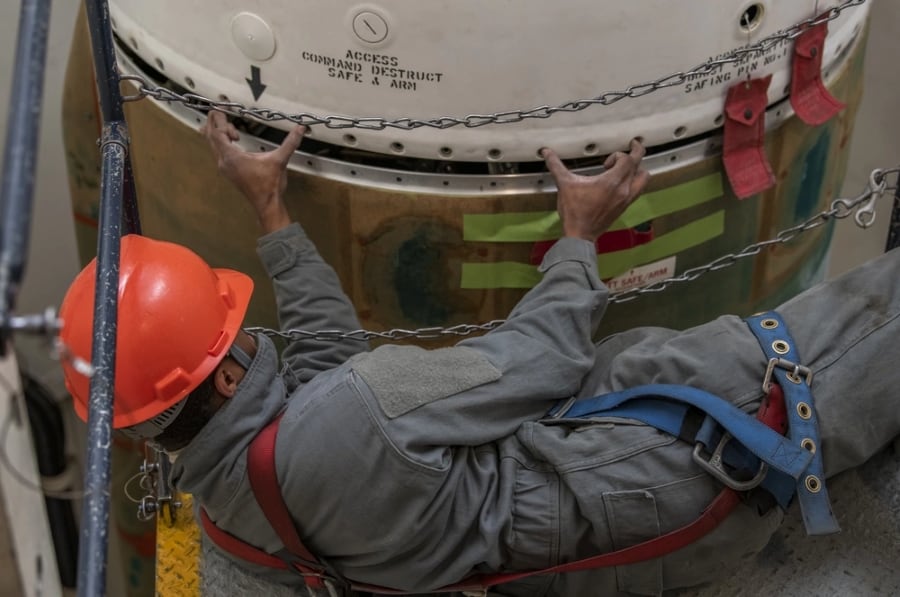
Units within the Air Force Global Strike Command were directed to cease use of a communications system at an intercontinental ballistic missile base after tests found residue of a carcinogenic chemical on one of the systems.
Personnel were told to stop use of the AN/PRM-10 test oscillator set, a signal generator, after an airman assigned to F.E. Warren Air Force Base, Wyoming, found traces of polychlorinated biphenyls, or PCBs, on a kit, according to a recent release.
The halt stemmed from a notification the command and 20th Air Force received in August that while performing a routine inspection of an AN/PRM-10 kit, the airman discovered and was exposed to the residue on a component of the kit.
“The Airman reported the issue, received medical attention, and was returned to duty with no adverse effects,” per the statement.
Additional testing confirmed the presence of PCBs in the residue. PCBs are a substance commonly used in electrical devices during the time the equipment was developed to maintain the Minuteman III ICBM system, per the release.
PCBs are a group of man-made organic chemicals that consist of carbon, hydrogen and chlorine atoms, according to the Environmental Protection Agency. The chemicals were domestically manufactured in the U.S. from 1929 until 1979, when their manufacturing and importation were banned due to evidence showing that the chemical was toxic to human health and the environment.
The Minuteman III ICBM system’s silos and underground control centers were built more than 60 years ago, and traces of PCBs have continued to be found at some nuclear bases. The chemicals have become a recurring concern as the Air Force investigates cancer risks among personnel in the nuclear missile community.
In 2023, the Air Force investigated three nuclear bases, including F.E. Warren, to see if the service could find harmful levels of the chemical. The force said that no harmful levels were found at F.E. Warren at the time, but results found harmful levels at two locations at Malmstrom Air Force Base, Montana.
The recent effort to halt the use of AN/PRM-10 is part of the 2023 Air Force initiative, called the Missile Community Cancer Study, to review the system and its equipment to confirm a “hazard-free working environment” for the ICBM community.
After the presence of PCBs in the kit, the 20th Air Force, which serves over F.E. Warren, ordered a one-time inspection to assess all AN/PRM-10 kits as well as updated safety warnings, precautions and mandatory personal protective equipment requirements where legacy testers are still used.
The one-time inspection was completed within three days of its order and found potential residue on six of eight AN/PRM-10 systems, the release says, which have been collected and sent for further testing.
The presence of potential residue on additional systems caused the 20th units to immediately cease the use of the AN/PRM-10, instead opting for a “modern, PCB-free replacement tester.”
Alongside the switch to a replacement tester, the command and 20th officials are working with the Minuteman III systems program office to dispose of existing AN/PRM-10 kits and identify other test equipment that may contain PCBs.
F.E. Warren, Malmstrom and Minot are the Air Force’s three IBCM bases. The bases are kept in a continuous state of full alert.
Out of the 400 Minuteman III ICBM systems, F.E. Warren operates 150.
“There are no mission impacts as a result of these actions, and U.S. ICBM forces remain safe, secure, and effective to protect the U.S. homeland,” the statement reads.
Cristina Stassis is a reporter covering stories surrounding the defense industry, national security, military/veteran affairs and more. She previously worked as an editorial fellow for Defense News in 2024 where she assisted the newsroom in breaking news across Sightline Media Group.