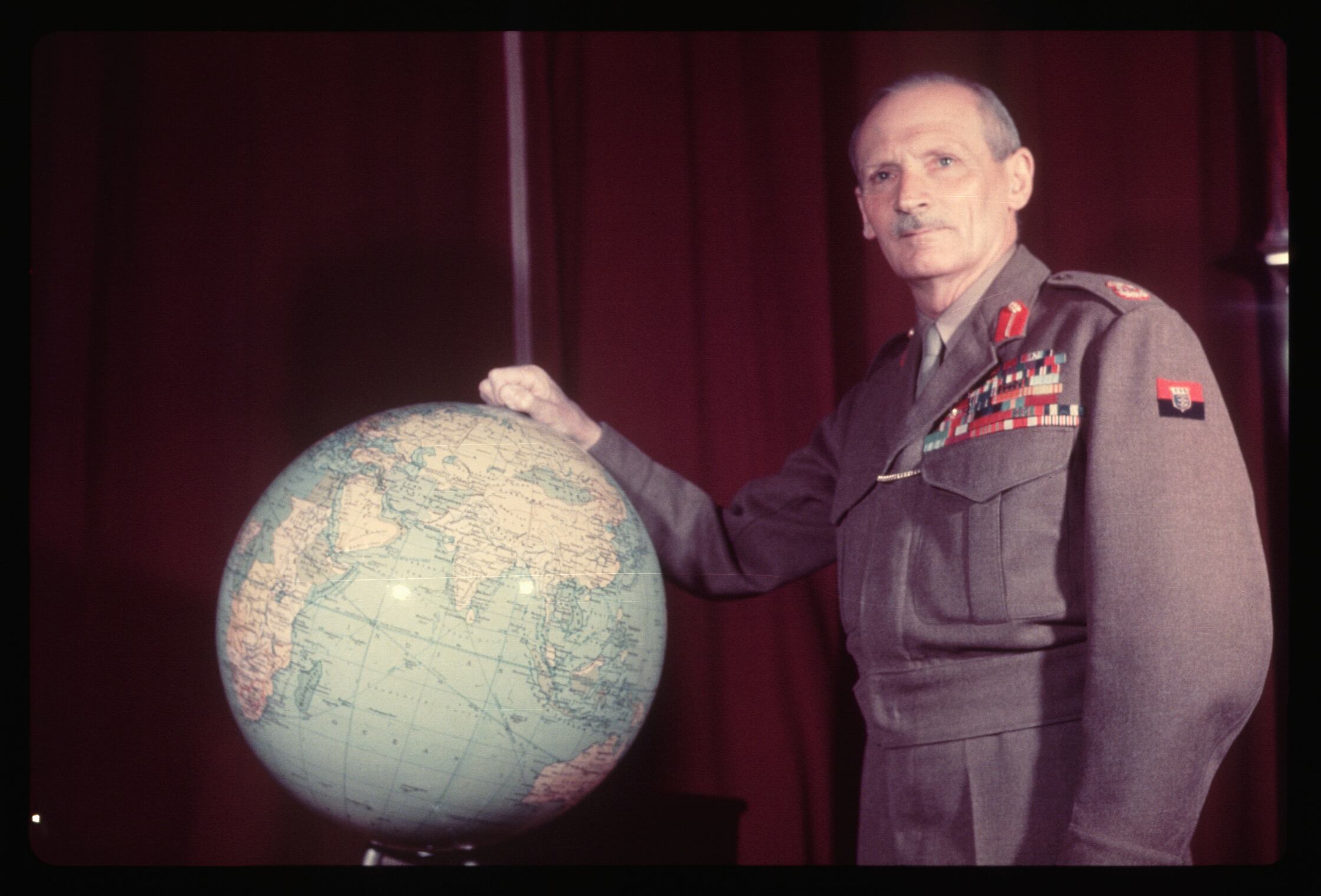
It might seem inconceivable that the use of drones in future battles would have come to the forefront of discussions of NATO strategy in the 1950s, but that is exactly what happened when Field Marshal Bernard Montgomery delivered an address to the Royal United Services Institute in 1954.
Montgomery, who helped create the foundations of NATO and was then serving as its Deputy Supreme Allied Commander Europe (DSACEUR), gave a speech entitled, “A Look Through A Window at World War III,” which stirred up much controversy at the time.
Many of the thoughts Montgomery expressed regarding Western defense and the evolution of war are still highly relevant in discussions of defense policy today.
Here is a look at some of Montgomery’s thoughts on NATO and how technology would change future battles.
Airpower
Montgomery predicted that airpower would become the dominant factor in war, that large surface vessels would become obsolete and that unmanned aerial systems — known to us as drones — would become ubiquitous.
“Later on…the East may have developed means of delivering their weapons with accuracy, both short-range and long-range, which do not rely on piloted aircraft,” Montgomery said. “Our ability to counter that threat by both offensive and defensive measures will be much reduced, because the targets will be far less vulnerable — whether they are launching sites, or the weapons themselves actually in the air.”
He presciently remarked that technology would eventually enable aircraft to “remain in the skies for prolonged periods and in all weathers,” adding, “That time is not yet, but it will come.”
Montgomery noted that he believed that there would always be some tactical need for piloted aircraft to perform specific support tasks, although the role of human pilots would be reduced.
He said that air dominance was of critical importance for NATO, as he believed that the West would struggle to maintain air superiority as new weapons developed.
Montgomery said that in case of a surprise assault, it was vital to “be able to hold such an attack long enough to enable nations to… mobilize their collective strength,” and that a response from NATO needed to consist of “an immediate air offensive on the largest possible scale, directed at the enemy’s air forces and at his homeland.”
Above all, Montgomery stressed that NATO countries needed to guard against a surprise aerial attack. This reflection was based on his observations of how airpower evolved during and after World War II, and the rising industrial strength of Communist nations. He stated emphatically that a future war would not see NATO allies have from the outset the same advantages in air superiority that the Allies had from 1943 onwards.
“Absolute defense against air attack will be impossible in the future. A deterrent, the means with which to hit back instantly and to give more than you receive, is the surest way to make an aggressor think twice before he attacks,” he said.
“We must develop an effective, and global, early warning system in order to have some chance of being able to take the offensive in the air should we be attacked,” he said.
He stated that he believed that “vertical lift aircraft” would be essential to achieve air dominance as this airpower could be dispersed and not an easy target for enemy forces. An astute analyst of military technology, Montgomery did not specify helicopters, but his remarks indicate that he believed vertical aircraft could develop in different forms.
“There is clearly a tremendous future of vertical lift aircraft and it must be exploited for the benefit of land forces,” Montgomery said.
A Hybrid Third World War
Montgomery believed that a potential third world war would consist of distinct phases: a battle for control of the air and seas, followed by hybrid attacks that could involve nuclear weapons — rather than the popular concept of a single nuclear strike.
“Those who are inclined to believe that future wars will be confined to push-button activities would do well to stop deluding themselves,” Montgomery argued.
He said that new technology would necessitate shrinking of naval forces, with the seas predominantly being controlled from the air and greater reliance overall on undersea vessels and smaller craft. Remarkably, he said he believed the aircraft carrier — which had risen to the peak of prominence in World War II — would eventually become obsolete.
He regarded it as vital for Western navies to still maintain control of the seas but be able and willing to adapt to new capabilities. As with airpower, Montgomery regarded force projection at sea as of critical importance.
“The first task of the Western naval forces is to make certain that they can deal with any challenge to our control of the seas, and that we do not lose that control,” he said.
Rapid Integration
Montgomery also stressed that the West needed to phase out weapons that become obsolete over time as technology progresses, noting that “the solution should be on the side of the long-term new weapons.” He also called for Western allied nations to create more flexible forces with an unprecedented degree of cohesion and interoperability between the services. Bureaucracy and duplication of effort, he said, were impeding the ability of military forces to be able to work effectively and be prepared to respond rapidly to threats.
“We seem to have lost the art of command, other than by paper,” said Montgomery. “No ordinary man can read half the paper that is in circulation; I doubt if the other half is worth reading.”
Raising the specter of nuclear war, Montgomery said he believed that governments needed to have measures in place to prevent and mitigate the damage of potential nuclear strikes, and above all, build up viable deterrents.
“As time passes and the offensive capability between East and West levels out, the advantage will go to that side which has the greater defensive strength, which can protect itself against attack, and can survive to strike back,” he said.
Zita Ballinger Fletcher previously served as editor of Military History Quarterly and Vietnam magazines and as the historian of the U.S. Drug Enforcement Administration. She holds an M.A. with distinction in military history.