source GAIA package: Sx_MilitaryTimes_M6201110109100314_5675.zip Origin key: Sx_MilitaryTimes_M6201110109100314 imported at Fri Jan 8 18:18:05 2016
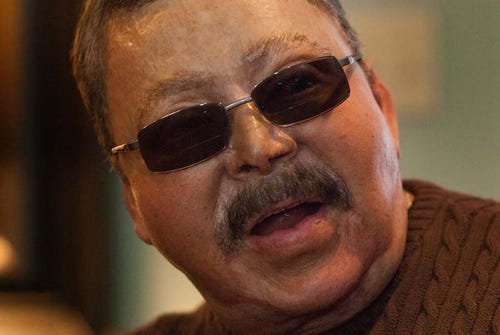
A few minutes after 9:37 a.m. on Sept. 11, 2001, Juan Cruz felt like “the only person alive in the whole universe.”
 Moments earlier, Cruz, then the head of the managerial accounting division in the Office of the Administrative Assistant for the Secretary of the Army, was waiting for two new employees to arrive in his Pentagon office for a welcome briefing.
 But those plans changed when work became survival after four terrorists crashed American Airlines Flight 77 into the west side of the Pentagon, killing themselves and 184 others.
 It was part of a day that would see 2,996 people lose their lives in coordinated al-Qaida attacks in New York City; Arlington, Va.; and Shanksville, Pa. — attacks that would plunge the country into what would become the longest conflict in U.S. history.
“I heard this extraordinary loud noise behind me,” Cruz said. “I thought it was a bomb. Everything was dark, smoke coming from everywhere and that terrible smell, which I learned later was jet fuel.”
Outside the Pentagon, the Rev. Steven McGraw was on his way to Arlington National Cemetery for a graveside ceremony. He’d been there before but had never driven the route himself.
McGraw was the newest priest at St. Anthony’s Parish in Falls Church, Va., ordained in June after leaving his previous career as a Justice Department attorney in 1997.
On his way to the cemetery, he took Route 27, which sits close to the west side of the Pentagon, to save some time — and ran into a huge traffic jam.
“I was in the left lane with my windows closed and didn’t hear anything until the plane was right above our cars,” McGraw said. “It clipped a light pole and crashed into the building.”
At the time, McGraw had not yet heard about the World Trade Center attacks earlier that morning and thought he was simply seeing a horrific accident.
“It looked like it was coming in for a landing, controlled and sort of straight, then there was an explosion and I felt the impact and watched as a fireball came out of two windows near the top of the Pentagon,” he said.
In the darkness inside the Pentagon just 100 yards from McGraw, Cruz heard voices calling for help and he yelled for them to get down on the floor.
The next thing he remembers was total silence, “like I was the only person alive in the whole universe,” he said.
“I was not afraid. Perhaps I was in shock,” Cruz said. “Next thing, I am asking my mother if I was having a nightmare and she said that everything was real and that I needed to do something to save my life.
“My mother has been dead for over 20 years.”
He started crawling, trying to find a way out of the wreckage. Suddenly he felt water on his back, cooling him off.
“I looked up and saw this large silhouette of a man with a helmet trying to reach me,” Cruz said.
That was when Cruz passed out and was carried from the building by firefighters.
“The next thing I know, I’m laying down somewhere outside the Pentagon. I do not know how I got there,” he said. “Someone asked me if I was Catholic and I said yes, and he started praying in English and I started praying in Spanish.”
It was Father McGraw, who had pulled off the road and grabbed his holy oils, prayer book and purple stole and walked into the triage area where Cruz was being treated.
Cruz felt himself in terrible pain and passed out, regaining consciousness briefly in a helicopter then later in the hospital.
Burned over 50 percent of his body, he has had a long recovery that is still ongoing. He is now retired because of his injuries.
In the early days, he would tell his family about the voice of his mother and the prayers of a stranger. They passed it off as hallucinations caused by delirium and pain — until a year later, when they saw the photograph.
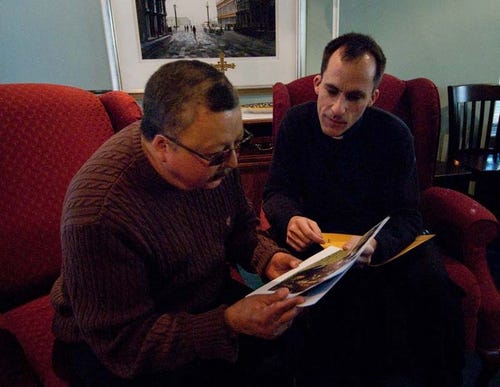
They were able to confirm it was Cruz in the photo, but it would be seven years before they met McGraw at his new parish in Fredericksburg, Va.
“It meant a lot to me to finally get to know Father,” Cruz said. “It was only through this picture that that was able to happen, and I’m forever grateful to him for praying with me that day.”
McGraw also drew closure from his long-delayed meeting with Cruz. At the reunion, McGraw described to Cruz a woman he also had ministered to near where Cruz lay.
Cruz identified her as Antoinette Sherman, who survived the attack only to die later in the hospital. She was one of nine co-workers — and of 40 from Cruz’s office — who died as a result of the attacks.
“She had told me to tell her parents that she loved them and I said I would,” McGraw said. “It was through meeting Juan Cruz I found her parents and was able to write them a letter.”
Though he never heard back from them, McGraw said he felt that he had kept his promise to Sherman.
“That meant a lot to me,” he said.