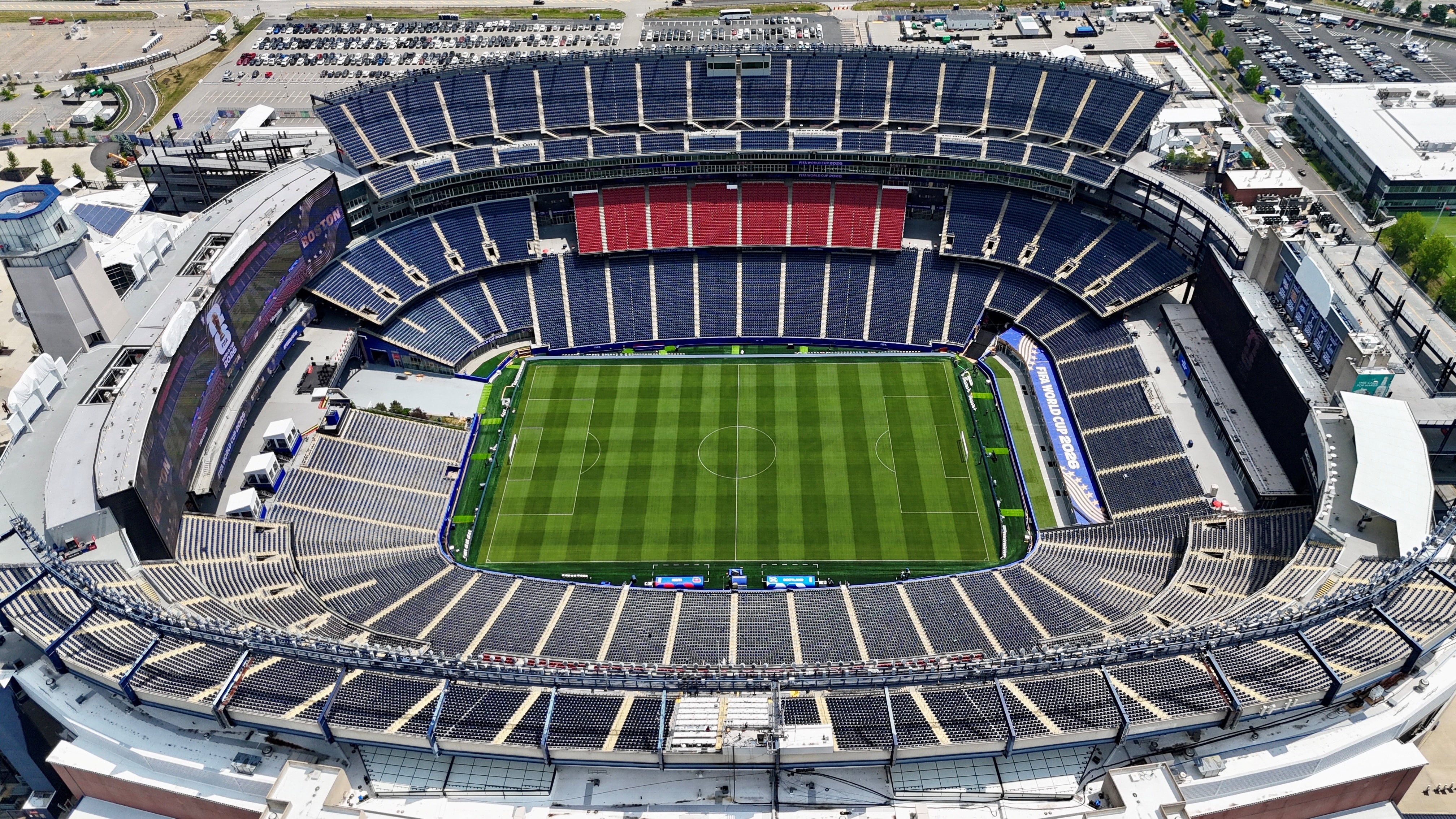
If any kind of aerial drone tries to breach a miles-long exclusion area above World Cup games in Boston and San Francisco, Coast Guard defense personnel will be able to use specialized equipment to seize remote control of the system and land or destroy it.
That’s according to Lt. James Hockler, the Coast Guard’s counter-unmanned aerial systems, or C-UAS, program manager. The smallest of all the military services, except the Space Force, and the only one that falls under the Department of Homeland Security instead of the Pentagon, the Coast Guard is nonetheless playing an outsized role in drone defense for major domestic events requiring unprecedented counter-drone response, including the World Cup and the Sail 250 maritime celebration.
In the yearlong leadup to these events, Hockler said in an interview Monday with Military Times, the Coast Guard spent a $150 million allocation to buy a variety of C-UAS systems for a “layered defense,” emphasizing electronic warfare measures to disrupt radio frequencies and opened a new counter-drone training and logistics center in Moyock, North Carolina, that will continue to conduct instruction and drills after this summer’s events have concluded.
The work is all illustrative of an emerging and deepening domestic security threat that will continue to tax federal and local agencies and increase costs and manpower requirements.
“This is actually the first time ever that the Coast Guard was able to execute simultaneous domestic deployment for counter-UAS capabilities,” Hockler said. “This really has been an all-hands-on-deck evolution.”
The Coast Guard established its Robotics and Autonomous Systems Program Executive Office last August “to accelerate the development, acquisition, fielding and sustainment” of unmanned platforms. It’s preparing to roll out a new job rating, Robotics Mission Specialist, and officials have said the 140 personnel trained to staff the World Cup and America’s 250th anniversary activities will be the first to transfer into the rating.
In addition to Boston and San Francisco, which will host a total of 13 World Cup matches, the Coast Guard is providing counter-drone support to Sail 250 cities, such as New Orleans, Norfolk, New York City and Baltimore, Hockler said.
Other U.S. cities hosting World Cup games are getting protection from federal agencies, including the FBI and DHS components from the Federal Air Marshal Service and the U.S. Secret Service to U.S. Customs and Border Protection. The FBI, Hockler said, used its own training center in Alabama to train local law enforcement agencies for each of the cities on drone threat detection and mitigation measures.
The Pentagon is also in on the action. Joint Interagency Task Force 401, the Army-run group that stood up last year to spearhead military counter-drone work, recently showcased a visit it had made to Kansas City, Missouri, to review preparations ahead of the events.
As the World Cup kicks off, Hockler said the Coast Guard is confident in its ability to pick up a drone signature anywhere in a no-fly zone by using Electro-Optical/Infra-Red cameras, or EO/IR, to detect activity in the dark. The cameras identify, track and monitor the threa and “mitigate” the system as needed.
“Our technology interrupts the radio frequencies between the controller and the drone itself, and we can essentially … take that drone and force it to land at a particular location, or we could force that drone right back to the pilot or the person on the controller,” he said. “We have a couple of different avenues of what we’re going to do for mitigation.”
The first 36 Coast Guard personnel trained in Moyock were designated “watch captains” and tasked with helping to train additional operators coming through the course. Those watch captains are now at the front lines in cities designated for C-UAS defense.
“Operators may have to go out to troubleshoot something or reposition an antenna; they may also be part of a mobile team that just patrols around and can pick up any weak spots during the game,” Hockler said.
“Because when you get a lot of that [radio frequency] noise when everyone’s cell phones going off and media presence and everybody’s got a lot of RF noise in the area, we may have to kind of tweak a few things, so sending people out to different sensor locations and and then having some of our watch captains and operators right there on the consoles, ensuring that they’re watching the watching all the screens is essential,” he continued.
After-action reports will capture what’s learned from protecting the events. But Hockler said the service has already assessed that it needs more of everything when it comes to counter-drone protection.
“We’re learning that the need is there for additional counter-UAS equipment,” he said. “The need is therefore to get additional people trained … in our long term, having this rating stood up, we’ll be able to expand upon this mission, and not have it as just a collateral duty, it can be a full-time job for our service men and women.”
When the games and sailing events are wrapped, Hockler said, the equipment and protective systems will all return to Moyock, ready to support the next major domestic event.