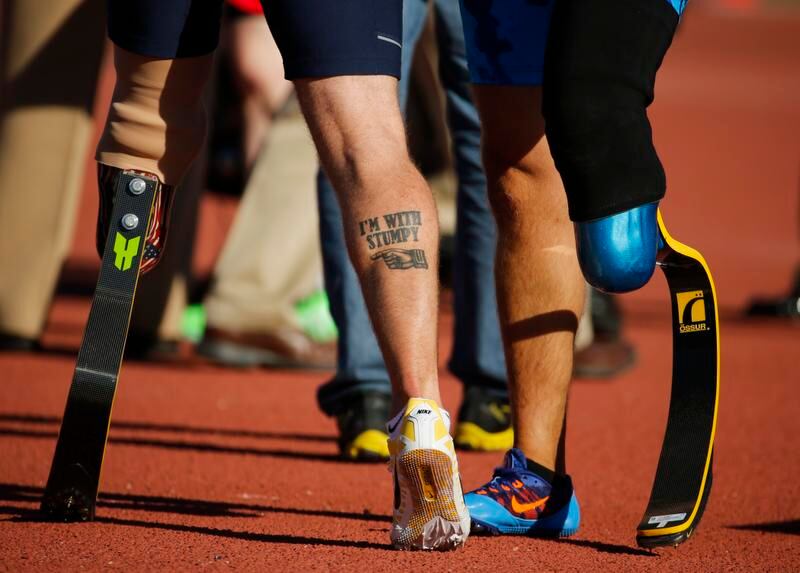
Prosthetic technology has come a long way in the last few decades, offering state-of-the-art robotic arms, carbon-fiber blades and joints that contain microchips and processors.
But artificial limbs still are attached to stumps that can swell, chafe, inflame and rub — problems that sometimes keep amputees from using their devices.
Now a Sandia National Laboratories researcher in Albuquerque, New Mexico, has developed sensors that can be integrated into a prosthetic socket to monitor pressure changes and fit, and tell users of fluctuations.
The sensor, developed by researcher Jason Wheeler and the lab's Intelligent Systems, Robotics and Cybernetics group, monitors pressure in three directions: downward or "normal" pressure, which is felt when something presses down on a surface, and two directions of "shear pressure," or sliding.
Shear forces are important, Wheeler explained, because they're what cause rubbing, blisters and scrapes.
"It can result in blistering, pressure ulcers, abrasions in the skin, and there also are issues with temperature and moisture management, which allow things to slip or swell. We want to monitor this all the time," Wheeler said.
As amputees use their prosthetics during the day, fluids in the limb shift and muscles can shrink. Custom-fit sockets don't adapt to these daily changes, nor do they self-adjust to a wearer's weight gain or loss.
But the sensors developed by Sandia can be integrated into special liners that would adjust automatically to changes, moving liquid into or out of bladders inside the liners to automatically improve fit.
Such advanced prosthetic interfaces would improve troops' lives, Wheeler said, and likely save money because they would reduce the number of times amputees must be refitted with new sockets.
Such high-tech liners are still in testing, Wheeler said. Researchers are fine-tuning the integration of sensor readings and fluid movement inside the liners.
"We've got it to a point where they are ready to be used in a clinical environment," Wheeler said. "We still need to do more studies, though, about how to adjust socket shape."
Sandia officials said that while sensors already have been developed for prosthetic sockets, the new three-axis pressure sensor is the first of its kind.
Nearly 1,160 combat veterans of the wars in Iraq and Afghanistan suffered a major limb amputation as the result of wounds. Overall, the Veterans Health Administration cares for more than 45,000 amputees and performs roughly 5,000 amputations a year, according to Veterans Affairs Department figures.
The research was funded by the Defense Department's Peer Reviewed Orthopedic Research Program.
Wheeler said his group is searching for a company interested in manufacturing and marketing the devices.
"An optimistic view would be that we would have something [on the market] in two to five years, two being the most aggressive if [federal] exemptions and everything were granted quickly," he said. "Essentially, the technology is close to full capability. The question becomes how long it takes to get through the manufacturing, distribution and approval process."
Patricia Kime is a senior writer covering military and veterans health care, medicine and personnel issues.