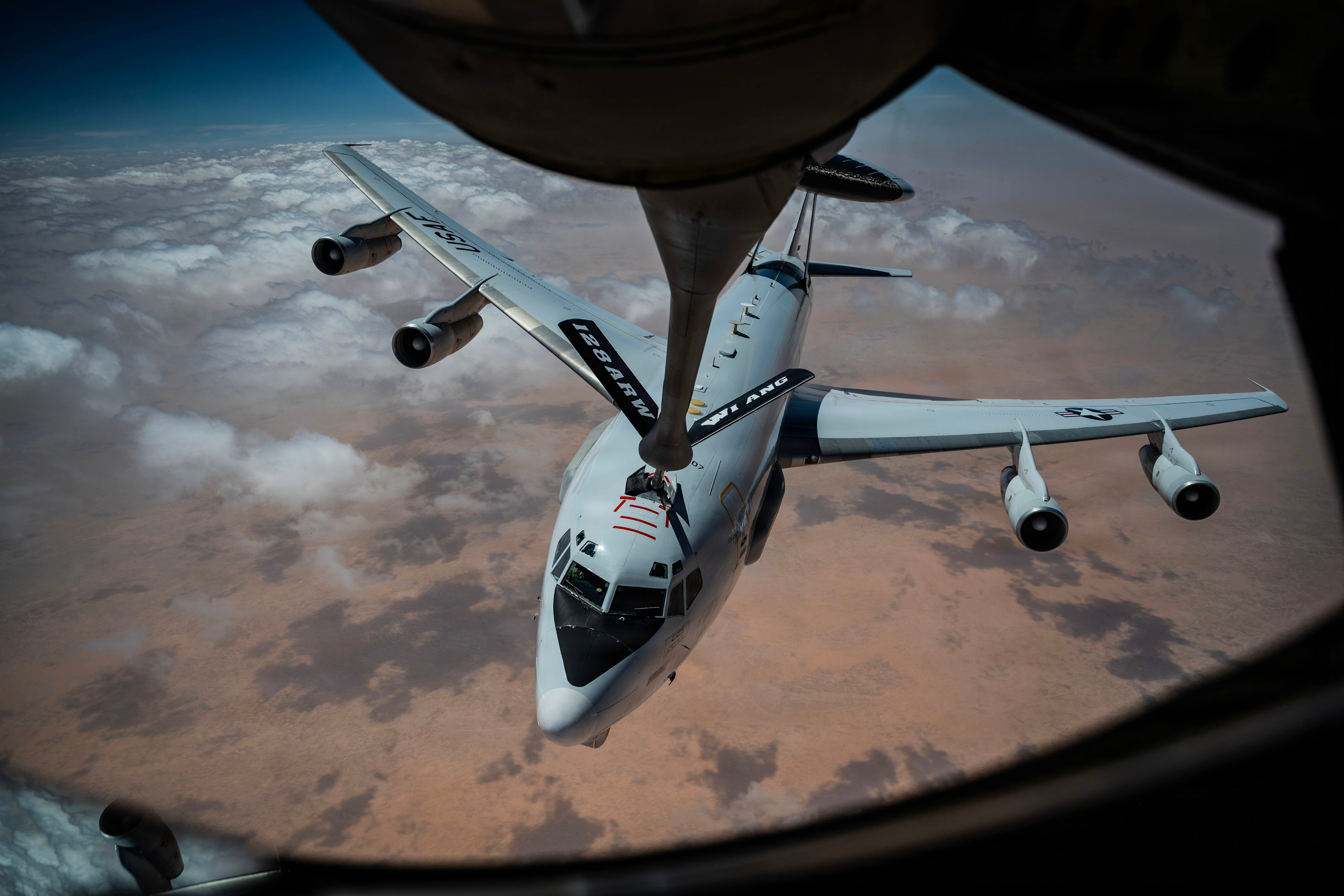
Fewer U.S. Air Force tankers are available for aerial refueling missions than official figures suggest, according to a new report.
The problem is how the Air Force defines a tanker as mission-capable. A tanker that is available for non-refueling missions such as medevac or cargo transport will be rated as mission-capable — even if it can’t perform refueling.
It is a second category, fully mission capable, or FMC, that rates whether a tanker is available for the refueling task.
“The percentage of aerial refueling tankers that are available and mission capable has remained persistently below the standards that the Air Force established for the fleet,” warned the Government Accountability Office report, which examined the tanker fleet from 2019 to 2025.
“Moreover, the percentage of fully mission capable tankers — those capable of performing all their missions — is even smaller.”
Exactly how many tankers are — or are not — partly or fully mission capable isn’t in the GAO report. The new report is a public version of a May 2026 study that was deemed Controlled Unclassified Information because tanker availability rates were regarded as too sensitive.
As of March 2026, the Air Force reported 373 KC-135 and 103 KC-46A tankers, GAO said. Given how absolutely indispensable tankers are to U.S. air operations, knowing exactly how many are available for refueling missions is vital.
In addition to questionable availability rates, the Air Force tanker fleet also suffers from severe sustainment issues.
For the venerable KC-135, which entered service in 1957, finding spare parts is a challenge. Yet because of problems with the KC-46A — a converted Boeing 767 airliner — such as the aircraft’s refueling boom, the Air Force has been forced to still rely on the KC-135.
“Maintainers from multiple units told us they considered parts shortages to be the key contributing factor to low availability and capability rates,” said GAO. “For example, KC-135 maintainers from one unit said they have planes that are sometimes grounded for many months due to unavailable parts.”
A previous GAO report found that the Air Force was underestimating delays in aircraft maintenance due to overworked repair depots. The new tanker study found that the Air Force tanker fleet suffers from lack of skilled maintainers as well as insufficient new infrastructure to support the KC-46A.
All of which is forcing Air Force units to find creative ways to keep the flying gas stations aloft.
“For example, unit officials at Tinker Air Force Base discussed ‘regionalization’ efforts, where bases ‘borrow’ aircraft from each other to meet their mission needs,” GAO said.
“Air Mobility Command officials told us about ongoing discussions to increase the amount of time between scheduled depot maintenance periods from 5 to 6 years, which they estimated would increase the availability of aircraft by about 6 percent,” the report added.
GAO recommended that the Air Force establish standards to specifically assess the aerial refueling capability of the tanker fleet. In addition, the Air Force should develop a plan to mitigate long-term risks for sustaining its tankers.
Michael Peck is a correspondent for Defense News and a columnist for the Center for European Policy Analysis. He holds an M.A. in political science from Rutgers University. Find him at theuncommondefense.com. His email is mikedefense1@gmail.com.