"Give blood ... play rugby." Heard that?
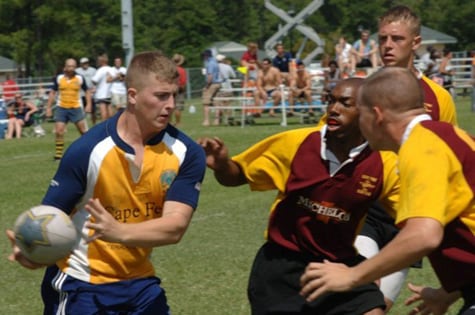
I feel like rugby is a cross between football and ultimate fighting. I've never had an interest in playing, mainly because I'm a giant chicken when it comes to contact sports. Especially ones without pads -- someone is probably bleeding before the match even starts. That said, I'm still fascinated by the sport, and by the guys (and brutally-fierce girls) who set out like bulldozers to obliterate their opponents.
One of these guys is Marine Corps Sgt. Othello S. Dayse from MCAS Cherry Point, N.C. The 28-year-old started playing rugby in 2002 for the University of South Carolina after he saw a rugby flyer in his dorm.
"I'd never heard of it before the flyer," he told me in an email. "I actually thought rugby was shot put. It was definitely not shot put."
Dayse went on to explain how he felt after his first rugby practice:
"When I went out to practice for the first time and got to run and tackle, I was hooked. It is a very physically demanding sport. Unlike football, the play is continuous, you're always running. You run and get tackled, then you jump to your feet -- just to run and support someone else who is about to get tackled -- or run and prepare to exploit an advantage."
Dayse, originally from Charleston, S.C., wrote in to share how he stays at the top of his rugby game.
Methodology:
My goal, when I work out, is to gain strength and maintain endurance. Rugby is not like football; play is continuous. As a winger, I am constantly running around the field , supporting and scoring, and sometimes I have to oppose a player or players who are much bigger than me, holding them just long enough for my support to reach me. Once they are there I have to quickly disengage myself from the breakdown and run back to my position, ready for another phase of play. So in my position, strength and endurance are key.
Workouts:
My workout involves nine exercises: bench press, incline press, tricep press, pushups, crunches, tricep pulldown, lat pulldown, forward and reverse flys and leg press. I do the same number of sets for each exercise with the exception of the crunches and the pushups. My goal for each is two sets of 10; one at a high weight and the other 10 pounds less. For example, for my bench I do 205 ten times for one set and then 195 for the second set. On the fourth day of my cycle I do two sets of five; the first set being 20 pounds above my heaviest weight and the second, subtract 10 pounds.
In the middle of my workout, on normal days, I do six sets of crunches with 25 reps to the left, forward and to the right. That totals out to 450 crunches or 150 per core section. On my heavy day, I raise it one more set. After the crunches I do 70 quick pushups on my normal day and on my heavy day I do 80. The crunches and the pushups constitute the extent of my core exercise.
Frequency:
I do cardio nearly every day, whether it be running at practice and racquetball, or running at the gym then at practice. I do weightlifting/core training in cycles that consist of four days with one day of rest in between each day.
Cardio:
We practice three times a week and since I am in the back line our practice consists mostly of sprinting. During my off time I play about six to nine hours of racquetball a week. I also run two miles before I start weight and core training.
Diet:
My diet is pretty healthy (for the most part). It is non-restrictive though. Only a couple of things that I make sure I do consistently: eat a lot of leafy vegetables and eat very little red meat, on the order of a serving or two a month. I also eat a lot of greek yogurt which helps me maintain some of the muscle that I gain.
Dayse said anyone interested in the Cherry Point team can find information on the Cherry Point Rugby Facebook page. For others who want to get started in the sport, he suggested searching the usarugby.com site under "Find a Club."
Want to be in PT365? Find out how here.