Just after midnight on Monday, July 30, 1945, the first Japanese torpedo slammed into the USS Indianapolis’s starboard bow. Then another.
Within 12 minutes, the heavy cruiser sank — taking hundreds of its crew with it.
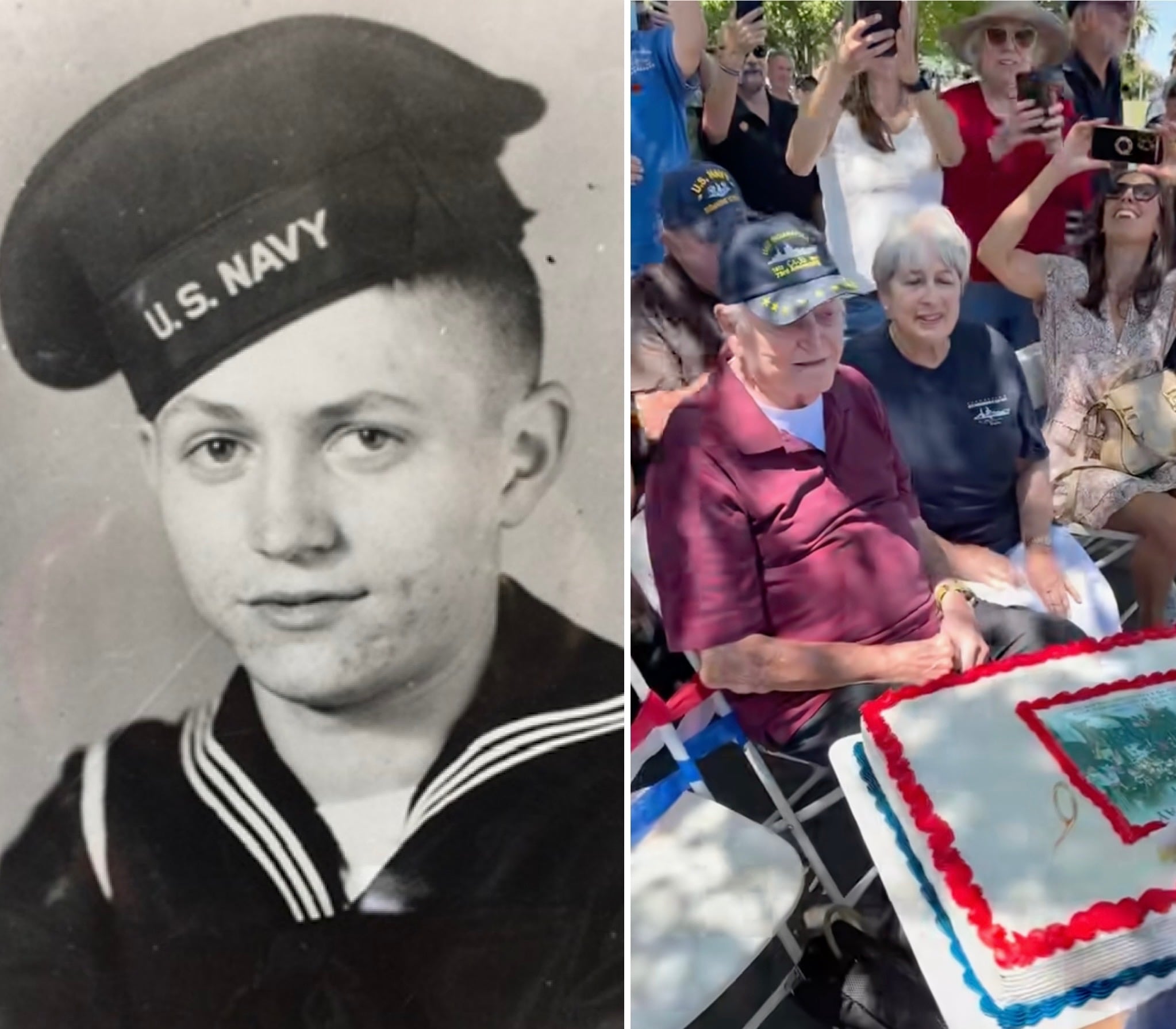
Only 316 men of the original 1,195 were alive, making the sinking the greatest loss of life at sea in American military history. Among those 316 sailors was Seaman Second Class Harold Bray, who today is the last living survivor of that wartime catastrophe.
On June 13, Bray’s 99th birthday, the Benicia Community Foundation, in partnership with the City of Benicia, California, honored the former sailor with a final dedication of a monument that pays tribute to Bray and those who served aboard the USS Indianapolis.
“What began as a vision became a community mission,” David Batchelor, chair of the Benicia Community Foundation, said in a press release. “This monument was built with heart. The city, local contractors, volunteers, veterans’ groups, donors, and supporters gave far more than labor or materials. They gave pride, patriotism, and a lasting gift to the City of Benicia.”
The monument, including a life-sized bronze statue of Bray, was unveiled in 2023. The statue includes details such as the veteran’s wristwatch that was stopped at the exact time Bray would have hit the water. The ceremony on Saturday marks the completion of the years-long monument project.
At the time of the sinking, Bray had been on the ship only two weeks — it was his first duty station.
“It seemed as if I had just drifted off when I was awakened suddenly by the ship shaking. I don’t remember hearing any explosion,” Bray recalled in the bestselling book “Indianapolis: The True Story of the Worst Sea Disaster in U.S. Naval History and the Fifty-Year Fight to Exonerate an Innocent Man,” by Lynn Vincent and Sara Vladic.
Some 300 sailors were immediately trapped in the hull of the ship as it went down, with 880 men expelled into the ink-black ocean.
Over the next five nights and four days, roughly 300 surviving sailors coalesced into a single, large mass.
“Some of these men only had life jackets; others, nothing at all. Other survivors were fortunate enough to find floater nets and rafts equipped with meager rations, flares, fishing supplies, and flashlights,” writes Vincent and Vladic.
According to Bray, “There was a lot of speculation and conversation about what had happened and how long it would take to find us. Everyone thought we would be picked up the next day or in a few hours. Well, none of that came to be true.
“The first day in the water was pretty horrific for this first-time sailor. Sharks — I had not in my wildest dreams thought I would ever be that close to those creatures, but there they were! The men with bad wounds or burns did not last very long. During the day the sun was very hot, and at night it was very cold. After a while, the men developed saltwater sores and blisters, and they would drink the salt water and get blisters inside their mouths and throats.
“Around the third day some of the guys started to act and talk kind of strange, so I stayed to myself as much as I could. At night I would get up in the middle of the net, so if I did happen to fall asleep, I wouldn’t float away. We lost a lot of good young men the first three days in the water.”
As many as 150 sailors may have been killed in shark attacks.
By mere happenstance, Wilbur “Chuck” Gwinn, a Navy pilot, was flying over the Philippine Sea in his Lockheed PV-1 Ventura bomber on the morning of Aug. 2. Gwinn had ducked into the belly of the bomber to help his crew untangle a new trailing antenna when he looked down — and spotted people.
From there, calls went out to help the survivors.
Bray recalled to Military Times that he knew he would survive when he saw Gwinn’s PV-1.
After the war, the longtime resident of Benicia, California, joined the police force, becoming a detective.
“Harold really was and is the champion of people,” Vladic told Military Times. “He loves everyone. What he is known for in the community [is being] the guy in the neighborhood that would take kids from rough backgrounds and help them. He would give them a second chance. So many people came up during the initial unveiling of the statue, saying, ‘He kept me out of jail as a kid.’ He wouldn’t arrest him, he would help him, and that’s what everybody knew Harold for.”
Bray is also known for his humor, Vladic noted, saying, “You know Harold loves you when he sasses you.”
Perhaps that explains Bray’s final piece of advice regarding longevity.
“Learn to swim,” he quipped.
Claire Barrett is an editor and military history correspondent for Military Times. She is also a World War II researcher with an unparalleled affinity for Sir Winston Churchill and Michigan football.