source GAIA package: Sx_MilitaryTimes_M6201110110040321_9E88.zip Origin key: Sx_MilitaryTimes_M6201110110040321 imported at Thu Jan 21 13:48:31 2016
Fisherman Jimmie Eady was packing the afternoon's catch of red grouper and triggerfish into the hold of his 35-foot-long boat on Aug. 17 when he heard the first round hit.
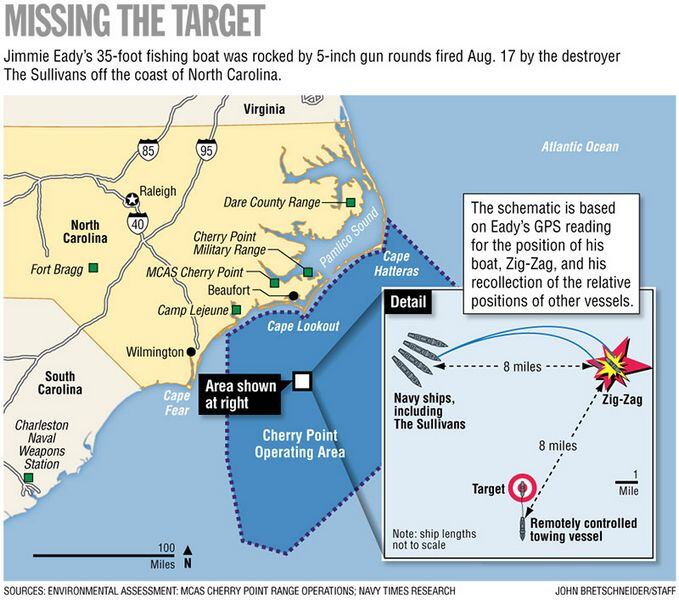
 It landed with a thunderclap in the Atlantic Ocean about 75 feet from Zig-Zag, Eady's commercial fishing boat, which had been fishing roughly 48 miles off the North Carolina coast. The round kicked up a splash large enough to soak Zig-Zag's deck and canopy. The impact jarred the boat.
 Then, moments later, came another roar. This one splashed closer. And another.
The hits encircled the boat, raising a shroud of spray. After a momentary shock, Eady and his two crew members realized they were being bombarded by the deck gun of one of the Navy warships about eight miles away.
"Cease fire! Cease fire!" Eady shouted into his VHF radio as more 5-inch gun rounds pounded the water. "You're gonna kill us!"
A round landed 20 feet off the bow, Eady recalled, right as the warships began to repeat "cease fire" on bridge-to-bridge channel 16. The gun fell silent. Fourteen inert rounds had been fired. Zig-Zag wasn't damaged and no one was hurt — the immediate aftermath was "just some shook-up fishermen," Eady later recounted. The 49-year-old fisherman pulled up the anchor and gunned the motor, steering away from the warships.
Eady and his crew had become the inadvertent target of the destroyer The Sullivans, which was conducting a gunnery exercise against what it thought was a towed target in the Cherry Point Operating Area off North Carolina. After an investigation into the incident, the destroyer's commanding officer was fired Sept. 7 — which was to be the ship's deployment date — and the ship was ordered to recertify under a new CO. The new requirement delayed the ship's deployment, forcing the Navy to extend the deployment of the cruiser Monterey, a ballistic-missile defense ship in 6th Fleet that has already been deployed for six months.
Cmdr. Mark Olson was relieved by Vice Adm. Daniel Holloway, 2nd Fleet commander. "Olson's failure to follow established procedures resulted in USS The Sullivans targeting a civilian fishing vessel, which was mistaken for a towed target that The Sullivans was directed to engage," the Navy said in a Sept. 7 news release.
Olson was the 18th CO fired this year, surpassing last year's tally of 17. Olson is the fifth ship CO to be sacked this year and the second to be fired from the Mayport, Fla.-based The Sullivans in 16 months. In March 2010, the ship struck a buoy while entering the port of Manama, Bahrain. The commanding officer, Cmdr. Neil Funtanilla, was fired two months later.
Holloway ordered a command investigation, which began Aug. 19 and is ongoing, said 2nd Fleet spokeswoman Cmdr. Elissa Smith.
"Both the target vessel and the fishing vessel were very small, and the fishing vessel was on the firing range," Smith said. "The investigation revealed that the ship should have been able to distinguish between the two vessels and prevent the incident."
Asked if any crew members other than the CO had been reprimanded, she replied, "It would be inappropriate to comment on any additional actions taken or contemplated at this time."
A commanding officer with BMD expertise was cross-decked on short-notice to take over The Sullivans, complete the training cycle and head out on cruise.
Two retired warship captains, who were not privy to specific details of the accident, said multiple safety measures appeared to have been improperly followed; the captains were at a loss to explain an error of this magnitude.
Eady, reached three weeks afterward, was still irate. Neither he nor his crew had been contacted by the Navy or provided their account to any investigators; he hadn't known which ship had fired at him until Navy Times informed him.
The vessel towing the target, Eady estimated, was eight miles south of them — "Way, way away from us when they started to shoot," he said. Pointing out that Zig-Zag had been at anchor while the real target was being towed, he said, "I don't know how they got that confused."
Reached at his Jacksonville, Fla., home on Sept. 8, Olson declined to comment on the incident and referred questions to Naval Surface Force Atlantic.
Exercise gone wrong
Around 4 p.m. that day, the training support vessel Prevail had hailed Zig-Zag on the radio to say that live-fire exercises would be conducted in the area and to find out Zig-Zag's intentions, Eady recalled in a phone interview Sept. 8.
At the time, Zig-Zag was about to anchor in a fishing spot. Eady replied, "We're going to make one stop here and go off to the northeast and get out of your way," he recalled saying.
Eady said Prevail concurred with this plan, although he couldn't recall exactly what was said. Prevail passed about two miles away and headed south. The fishermen noticed four warships about eight miles west of them, on the horizon.
This differs from Navy officials' accounts. Officials said they understood from the conversation that Eady would leave shortly.
The Sullivans' intended target was a 15-foot-long fiberglass boat, minus an engine, brightened with a large orange reflective screen. This target, in turn, was towed by a remotely controlled vessel. The other ships participating in the exercise were the destroyers Donald Cook and James E. Williams, and the dock landing ship Oak Hill.
Prevail, which was remotely controlling the target from five miles away, told Zig-Zag over the radio that the gunnery exercise was about to commence and to head east. According to Smith, the Zig-Zag replied that they "had a fish on the line" and would head east soon.
After the radio exchange, Eady and his crew dropped the hook and began fishing in the 23-fathom water with their four hydraulic fishing reels.
"It was calm, it was pretty," Eady recalled of that afternoon, adding that there was some haze near the horizon from high humidity.
Eady was accustomed to fishing in these waters. After leaving the Coast Guard in the early 1980s, he began fishing off the North Carolina coast in 1982 and has been running his own boat for 15 years.
About an hour and a half later, the unmanned towing vessel and the towed target were about eight miles south-southwest and the fishermen were packing their catch into the refrigerated hold when they heard the first boom, Eady said.
James Lowe, Zig-Zag's 45-year-old first mate, had been working the reels that afternoon and hadn't paid much attention to the warships. Seeing the huge splash and roar, he was startled. His first thought: "Was that a warning shot telling us that we were in the wrong area?"
Eady said they were bombarded for two minutes, although Lowe recalled it happening over less than a minute, with the pace of the shots coming in quicker after the first one.
"After the first one landed, it was like three seconds and they were like a second-and-a-half apart then, and then they were going all the way around the boat," Lowe told Navy Times. Referring to Eady, Lowe continued, "I told him, 'If we don't go, the next one's going to be right in the fish box!'"
"He got on the radio and hollered, and they stopped firing," Lowe added.
Afterward, Eady and his crew pulled up the anchor and drove away from the warships at their best speed, about 16 knots. A Navy helicopter flew over Zig-Zag, making sure everything was all right. The Coast Guard contacted them and called the fishermen's families later, letting them know that they had been involved in an accident with the Navy and telling the families that they were unharmed. Eady and his crew stayed out to catch more fish and returned to Beaufort, N.C., two days later.
Smith confirmed that 14 5-inch rounds had been fired, landing within 50 feet of Zig-Zag. However, it was unclear what errors onboard The Sullivans led to the accident.
The Coast Guard, which had been required to broadcast Notice to Mariner messages, is conducting an administrative investigation into the handling of these messages for the gunnery exercise. It wasn't clear whether required messages were broadcast.
Lt. Mike Patterson, a spokesman for Coast Guard District 5, was unable to say whether the required messages were sent, due to the continuing investigation.
Schedules delayed
The Sullivans will now have to "complete necessary pre-deployment certifications that were disrupted by changes in the ship's schedule," 2nd Fleet said in the Sept. 7 release. Some of the certifications will have to take place under the new CO. Smith was unable to say what these certifications were, how much of the training cycle still had to be completed and when The Sullivans is expected to deploy.
Sixth Fleet spokesman Cmdr. Marc Boyd confirmed that the cruiser Monterey's deployment had been extended as a result of the delay with The Sullivans. Boyd declined to say how long the extension would be, citing Navy policy not to release ship schedules. Monterey deployed from Norfolk, Va., on March 7 on what the Navy said was to be a "six-month independent deployment" to 6th Fleet.
The mishap will most likely end Olson's promising career. A 1992 Naval Academy graduate, Olson entered the Navy from Mansfield, Ohio. He served as navigator on the destroyer Chandler, going on to command the patrol coastals Sirocco and Firebolt; he commanded Firebolt in the Persian Gulf in 2004. Olson served as executive officer of the cruiser Lake Erie before taking command of The Sullivans in May 2010. The 41-year-old has received a Bronze Star and the Defense Meritorious Service Medal, as well as 14 other achievement and campaign medals.
He was reassigned to administrative duties at Destroyer Squadron 14, 2nd Fleet said.
Range safety
Gunnery exercises are typically preceded by checks and double checks. The range must be clear of contacts. The target track must be properly identified. The gun must slew to the right target. These and other safety measures don't appear to have been conducted properly, the two former ship captains said.
A bedrock check is a simple visual verification of the target, said retired Cmdr. Bryan McGrath, who commanded the destroyer Bulkeley.
"If your radar is saying it's 010 [degrees] at 12,000 yards, you look out there and you say, 'Yes, that looks like the target,'" said McGrath, who retired in 2008 and is the director of consulting, studies and analysis with defense contractor Delex Systems.
In cases involving a towed target, McGrath said, it's essential to be in constant communication with the towing vessel or the vessel controlling it. The vessel provides a "Whiskey report," with the target's latitude and longitude, which are plotted by the warship and compared to a sighted target and the radar track.
"If you don't have good communications with that vessel, generally not a good idea to shoot at it," McGrath said.
He then ticked off other safety checks. The towing vessel should be identified as a friend — preventing it from being assigned an engagement order by the Aegis weapons system. The reported course and speed of the vessel should be compared with the radar track.
Safety measures involve both bridge watchstanders and those in the combat information center. At any point, a crew member calling out "check fire" would have halted the gun shoot.
"This is not a Jesse James free-for-all," McGrath added. "This is something that you practice, that you script and that you brief, and you go through very, very carefully."
Still, the thought of firing at the wrong target was something that lurked in the back of his mind when he was a CO.
"It's something that you fear," he said. "You recognize — especially when you're shooting close to land and it's fishing water — you want to make sure that you're shooting at the right person and that there isn't someone else around. It's something that you worry a great deal about."
The 5-inch gun is forward on a destroyer, meaning it should be easy for the bridge to check that the gun's bearing is on the right target, said a retired cruiser CO, who asked to remain anonymous because he didn't want to fray relations with the Navy, with whom he works as a contractor.
"It sounds to me like somebody just entered the wrong track," he said, "and the gun system did what the gun system will do: Just said, 'OK you want me to shoot that thing? I'll shoot that thing.'"
Other mistakes are more common, he said. Among them: The gun starts tracking the towing cable and shots walk toward the towing vessel, or the tug is mistaken for the towed target.
"It's hard to figure out how they mistook an actual fishing boat for the tow," he said, especially since Zig-Zag was anchored. "I'm having a hard time figuring out how they got so far out of whack."
To his mind, the ultimate responsibility for batteries release falls to the ship's CO. "You never have a situation where, 'Well, I told that guy to move, he didn't move. OK, batteries release, start shooting,'" he said. "You never get to that point."
Mr. Fix-it
The Sullivans' new CO is no stranger to problems. In fact, Cmdr. Sylvester Steele is becoming something of a troubleshooter, the guy called in to right a troubled ship.
In March, Steele got his first call. At the time, Steele, a 1995 academy grad, was XO of the Norfolk-based destroyer Ramage and was slated to become the ship's CO. He already was a ballistic-missile defense expert, having served at the Missile Defense Agency and as the Pacific Fleet's Integrated Air and Missile Defense officer.
Then new orders arrived: Steele was flown to the Mediterranean to take over the destroyer Stout, mid-deployment.
Stout's CO and command master chief had just been fired after a string of 6th Fleet liberty incidents, ranging from barroom brawls to fraternization and bullying.
Steele assumed command of Stout in the Mediterranean on March 6. Two weeks later, Stout fired Tomahawk cruise missiles at Libya as part of the NATO-led Odyssey Dawn campaign.
Stout returned to Norfolk on June 17 and entered dry dock in August. And that should have been that. Then on Sept. 7, he got another call. Steele was on a plane to Mayport that night to take the helm of The Sullivans.
"He's certainly an expert in the BMD field and he's got proven performance on deployment with a BMD-capable ship," said SURFLANT spokesman Lt. Cmdr. Bill Urban. "That's a big reason why he's going to take The Sullivans over there."
Urban said that after Steele takes The Sullivans on deployment, Steele will return to Stout as CO. Stout's XO, Lt. Cmdr. Robert Alpigini, has assumed command until Steele returns.