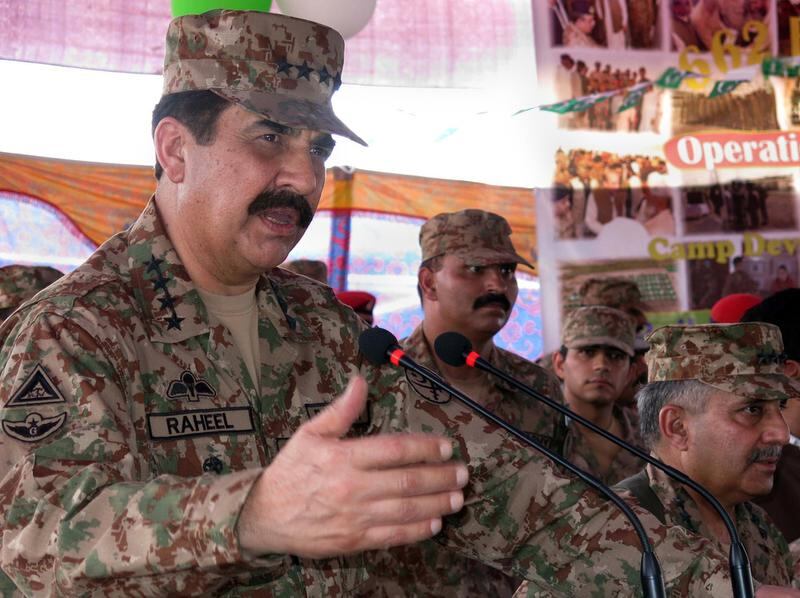
The Pakistan army's chief of staff is coming to the U.S. to meet with his American counterparts, the Defense Department has confirmed.
Gen. Raheel Sharif is expected to meet Defense Secretary Chuck Hagel and Army Gen. Martin Dempsey, chairman of the Joint Chiefs, during a weeklong visit to the U.S. that is expected to begin Nov. 16, the Pakistani newspaper Dawn reported on Sunday.
Marine Maj. Bradlee Avots, a DoD spokesman, confirmed that Sharif will met with "senior Department of Defense officials," but Avots did not have further information about who those officials are.
Dawn reported that Sharif is also expected to meet Gen. Lloyd Austin, chief of U.S. Central Command, but Army Maj. Brian Fickel, a CENTCOM spokesman, could not confirm that.
Sharif will be the first Pakistani army chief of staff to visit the U.S. since October 2010, said Shuja Nawaz, director of the South Asia Center at the Atlantic Council think tank in Washington, D.C. U.S.-Pakistani relations hit a low point the following year when Navy SEALs killed Osama bin Laden inside Pakistan.
"This is a rebuilding of the relationship from the depths it fell into in 2011 and 2012," Nawaz told Military Times on Tuesday.
Foremost on Sharif's mind will be the future of Pakistan's relationship with the U.S. after 2016, when the U.S. is expected to remove almost all its troops from Afghanistan, Nawaz said. The U.S. currently reimburses the Pakistani military for its counterterrorism operations. Since launching an offensive against the Pakistan Taliban in North Waziristan this summer, the Pakistani military has increased troop strength on the border with Afghanistan from 150,000 to 170,000.
"Along with this closure of the battle in Afghanistan, the coalition support funds will also dry up, so there will need to be the crafting of a new system to provide any support, and he will have to make a case — not just with his military counterparts, but with people in the [Obama] administration and on [Capitol] Hill — because there doesn't seem to be a great deal of enthusiasm on the Hill for continuing that relationship," Nawaz said.
Unlike past Pakistani military leaders, Sharif believes the internal threats to Pakistan's security are more dangerous than external ones, said Jason Campbell of the Rand Corp. think tank.
"He had a role in changing the way that the Pakistani military trains and prepares," Campbell said. "Rather than being a large conventional force trained to fight India, he was influential in turning them into more of a counterterrorism — in some ways, a counterinsurgency — force, equipped to deal with the internal threat as well. He brings a new mindset to his position. I think it's one that conforms pretty well with the way U.S. strategists see the threats in the region."
Sharif is likely to discuss the Pakistani military's progress against the Pakistani Taliban in North Waziristan, said Daniel Markey of the Council on Foreign Relations think tank in Washington, D.C. Despite the offensive's successes, the Pakistani military believes that the Pakistani Taliban, known as the Tehrik-i-Taliban Pakistan, have established "reverse safe-havens" inside Afghanistan, Markey told Military Times on Tuesday.
"They do believe that top Pakistani Taliban leaders, including the head of the TTP, are spending time in Afghanistan and may actually be getting some support from the Afghan state and intelligence service," Markey said.
Pakistan's suspicion may not be entirely far-fetched, Markey said. When U.S. special operations forces captured Pakistani militant Latif Mehsud last year inside Afghanistan, the New York Times reported that Mehsud was in secret talks with Afghanistan to form an alliance with the Pakistani Taliban against Pakistan.
During his visit to the U.S., Sharif is likely to discuss how the U.S. campaign of using drones to attack targets in Pakistan should continue after the U.S. draws down its forces in Afghanistan this year, Markey said. Recently, the U.S. has been targeting the Pakistani Taliban, a mutual enemy of the two countries. The question is what Pakistan will do if the U.S. attacks groups such as the Haqqani network, an insurgent group that reportedly has close ties to Pakistan's security forces.
Another concern for Pakistan is its deteriorating relationship with India, Markey said. Both countries have been exchanging artillery fire recently, leaving dozens of civilians dead in the sharpest increase in violence since the early 2000s.
Sharif "will also probably want to make a case to Washington that it's in our interest to get the Indians to calm down," Markey said. "I'm not sure how successful he'll be on that score."