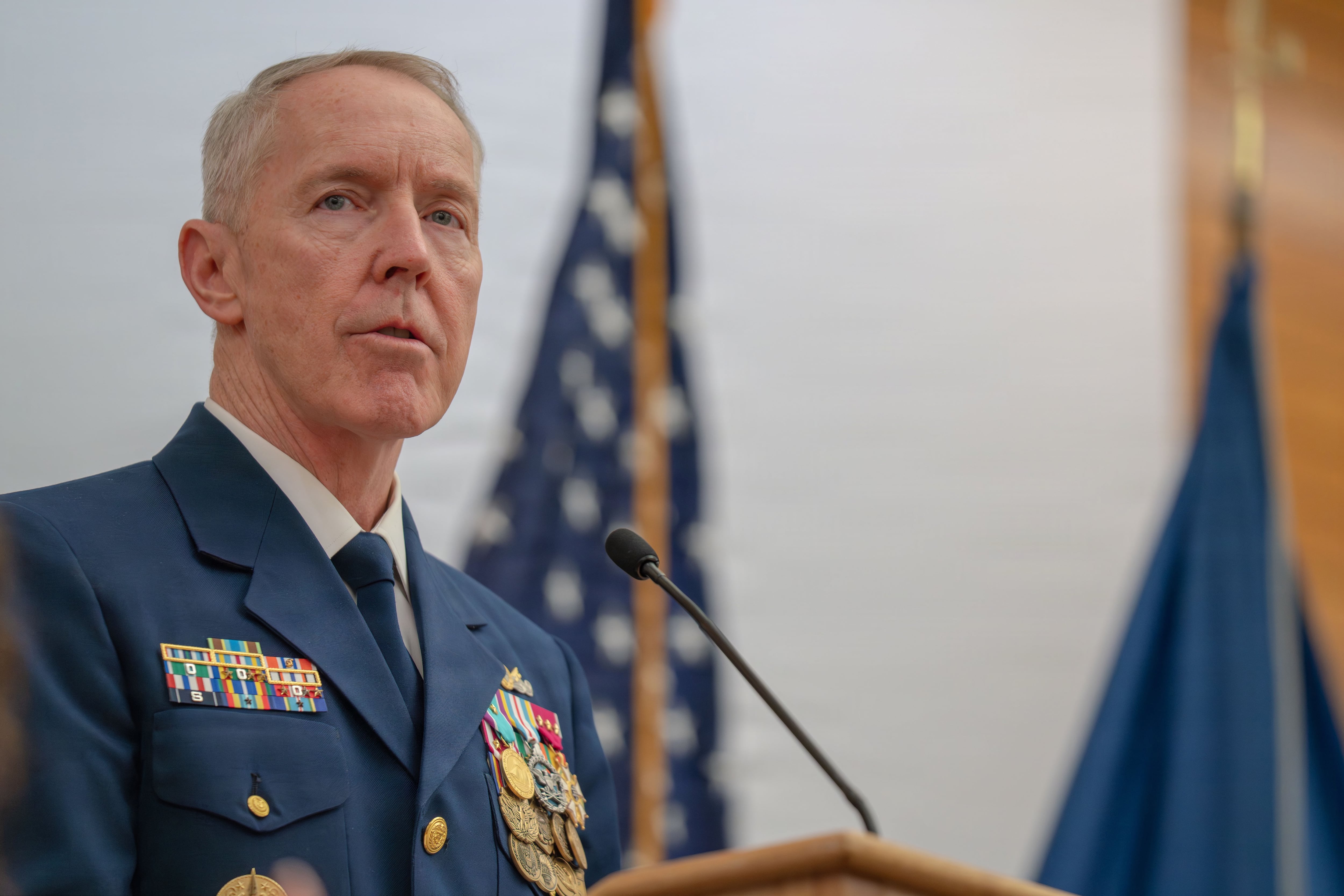
Adm. Kevin Lunday was sworn in Thursday as the U.S. Coast Guard’s 28th commandant, nearly a year after he had been acting in the role.
Lunday takes the service’s helm at a time of great transformation: The Coast Guard has embarked on a modernization plan that aims to grow the force by 15,000 and expand its capabilities through acquisitions and technology, while it also is actively engaged in significant interdiction and national security operations.
In a ceremony at Coast Guard Headquarters in Washington, Lunday said the service is in “greater demand than ever before,” and he promised it would become a more “agile, capable and responsive fighting force.”
“Like every Coast Guard crew on a mission, our service must do three things: ready, fight and navigate. And we must do them in that order,” Lunday said.
Under Lunday’s tenure as acting commandant, the Coast Guard launched Force Design 2028, an initiative that calls for restructuring the service’s headquarters, purchasing new aircraft, ships, drones and technology to support operations, improving infrastructure and increasing end-strength.
The Coast Guard received nearly $25 billion in resources in July from the Trump administration’s reconciliation bill — funding designed to fix the service’s crumbling infrastructure and invest in new technology and assets.
A progress update of Force Design 2028 released Thursday said the Coast Guard already has allocated $7.7 billion of the funds and plans to complete the process by next year.
Speaking at the Surface Navy Association’s annual symposium in Arlington, Virginia, on Wednesday, Sean Plankey, a senior adviser to Homeland Security Secretary Kristi Noem, said the rapid pace was necessary to ensure that the service becomes the Coast Guard “that America needs.”
“That money is taxpayer dollars, and those a taxpayer expects us to use that money to invest it for the American public,” Plankey said. “If we’re just sitting on the account saying, ‘We’re waiting on requirements, we’re figuring things out,’ it’s not going to change the service.”
Since the announcement of Force Design 2028, the service has reorganized 68% of its headquarters staff, creating a chief of staff and two deputy commandant positions, eliminated 14 flag officer positions and added program executive offices to manage acquisitions.
The Coast Guard has purchased two long-range command-and-control aircraft and invested in counter-unmanned aerial systems. It has also made investments in acquiring a new fleet of Arctic security cutters, ten additional fast response cutters, additional offshore patrol cutters and new polar icebreakers and waterways commerce cutters.
At the heart of this “bold course,” Lunday said, are Coast Guard men and women, which he called “our greatest treasure.”
“We will lead and inspire our crews to get the mission done while taking the very best care of them,” Lunday said.
Lunday was named acting commandant Jan. 21, 2025, when his predecessor, Adm. Linda Fagan, was fired from the job after serving in the position for nearly three years. Lunday, a 1987 graduate of the Coast Guard Academy, was appointment vice commandant in June 2024 and previously served as commander of Atlantic Area.
Previous assignments include commander of the 14th Coast Guard District, now known as Coast Guard Oceania District, and U.S. Coast Guard Cyber Command. He holds a Master of Science in national security strategy from the National War College and a law degree from George Washington University Law School.
During his swearing-in ceremony, Noem called Lunday a “special kind of leader” for “unprecedented times.”
“Over the past year, Adm. Lunday has proven that his leadership and dedication to the country is unprecedented. He has proven that he is dedicated to the success of the Coast Guard and he has proven it over and over. In fact, 2025 turned out to be one of the most significant and impactful in the Coast Guard’s history,” Noem said.
Lunday was slated to deliver a keynote address Wednesday at the Surface Navy Association meeting but he was called away for operational demands, organizers said.
A social media post Thursday by Noem gave some insight into Lunday’s absence: She announced that the Coast Guard had been involved in the seizure of a sixth sanctioned oil tanker the administration said has ties to Venezuela.
According to The Associated Press, a Coast Guard tactical team boarded the motor tanker Veronica with Marines and Navy sailors from the aircraft carrier USS Gerald R. Ford in the Caribbean Sea.
Patricia Kime is a senior writer covering military and veterans health care, medicine and personnel issues.