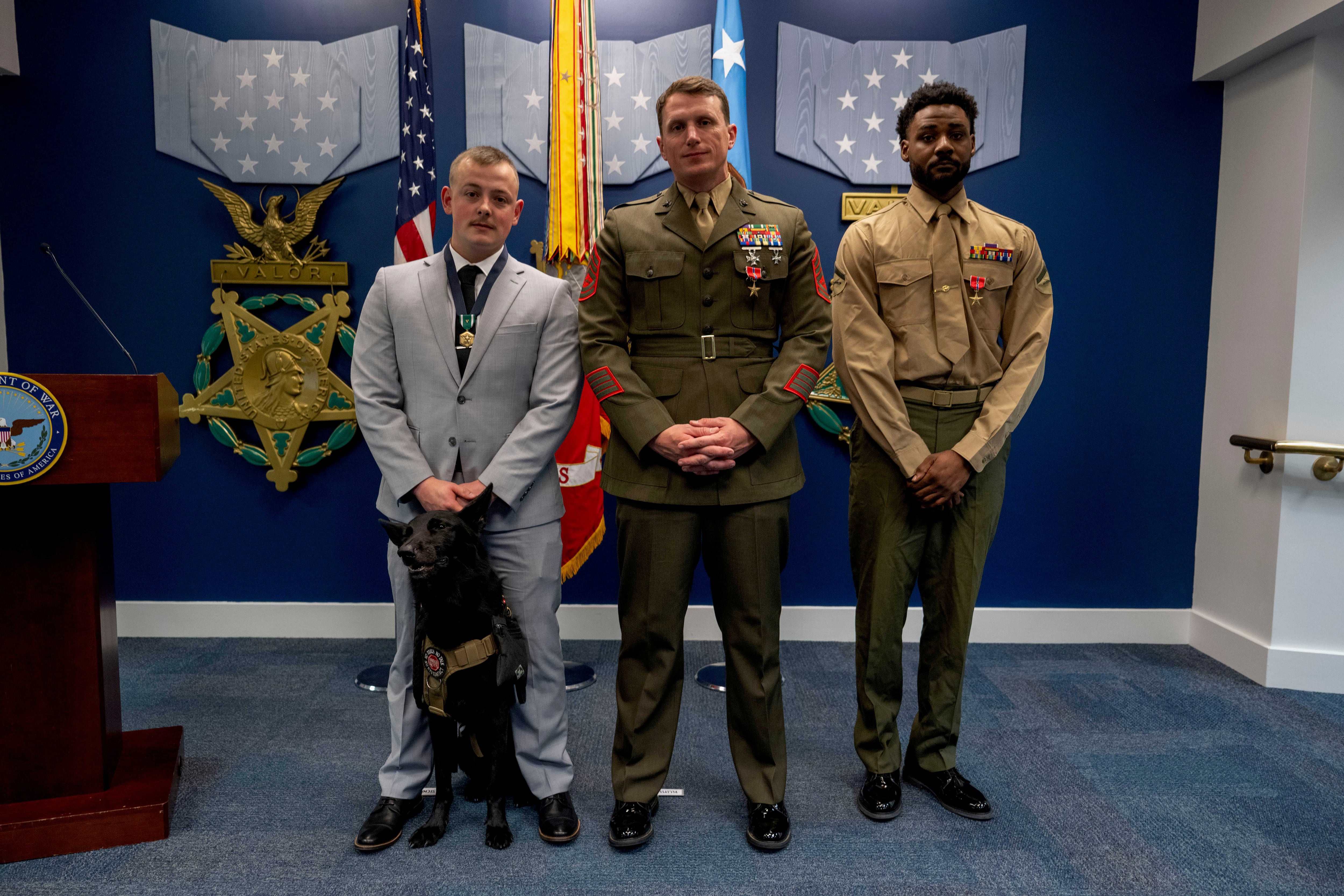
Five years after a suicide bombing killed 13 U.S. service members and around 170 civilians at Abbey Gate in Kabul, Afghanistan, the Pentagon upgraded the awards of three Marines who survived the blast and then worked to save others in its immediate aftermath.
The service members, assigned to 2nd Battalion, 1st Marines, were at the then-Hamid Karzai International Airport as America’s decades-long war in Afghanistan drew to a tumultuous close. Outside of the gate, where enormous crowds had frantically gathered in hopes of a safe evacuation from the country, an Islamic State bomber detonated the explosives on his body.
During a Wednesday ceremony at the Pentagon, Defense Secretary Pete Hegseth presented the Bronze Star Medal with Valor to retired Gunnery Sgt. Jonathan Eby and retired Lance Cpl. Jordan Houston, and the Navy and Marine Corps Commendation Medal with Valor to retired Cpl. Michael Gretzon.
Eby secured the area before helping to evacuate wounded Marines, Houston — who was injured himself — assisted others to safety despite gunfire and tear gas and Gretzon helped control the crowd from a vulnerable position after the blast, according to the department.
Hegseth used biblical language when describing the service members’ actions. “These three Marines embody a timeless truth written in the book of Proverbs: ‘The wicked flee when no one pursues, but the righteous are as bold as a lion.’ On that chaotic day, you men were as bold as lions,” he said, adding, “When the wicked sought to sow terror, these men stood as lions at the gate — bold in their purpose, fierce in their resolve and unbreakable in their courage.”
The bombing has been a centerpiece of the Trump administration’s criticism of former President Biden’s handling of the withdrawal. Under the Trump administration, the Pentagon established a review panel to investigate the bombing, chaired by Sean Parnell, the department’s chief spokesperson. In a statement on X, Parnell said that the panel had discovered “highly relevant classified documents — material that should have been disclosed — stashed and hidden away in safes where they would not be found.”
He did not elaborate on the content of those documents or provide a date for their release.
A Central Command review into the attack, released in 2024, found that the attack was not preventable, contradicting claims from service members who said they had seen the possible bomber but could not get approval to take action. The review found that the attacker did not fit the service members’ descriptions of a “bald man in black.”
Eve Sampson is a reporter and former Army officer. She has covered conflict across the world, writing for The New York Times, The Washington Post and The Associated Press.