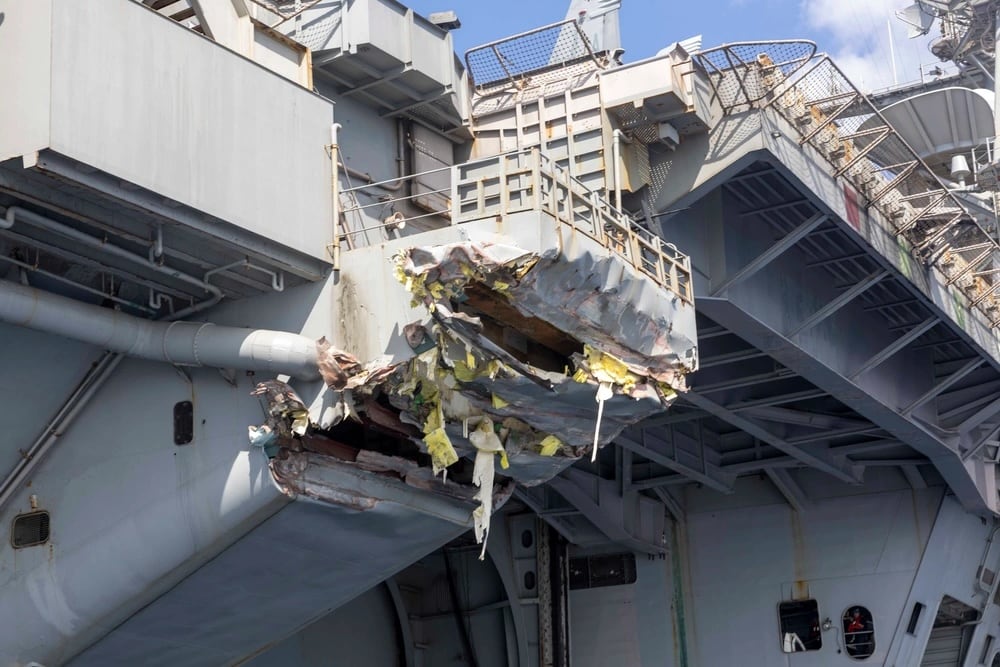
The U.S. Navy last week released a redacted version of its report on the USS Harry S. Truman’s Feb. 12 collision with a merchant vessel.
The public version of the March 19 report, now on the Navy’s Freedom of Information Act Reading Room site, identifies errors it says led to the collision and makes recommendations for how they might be avoided in the future.
Vice Adm. Jeffrey T. Anderson, commander of U.S. 6th Fleet, began the investigation Feb. 15, three days after the Truman collided with the Besiktas-M near Port Said, Egypt.
“Though no lives were lost in this incident,” the report says it “discusses how the outcome could easily have been much different.”
The aircraft carrier, then five months into a deployment, was able to continue its mission after the collision.
The report identified several human factors that played a part in the crash, including fatigue and schedule pressure.
Watch teams aboard vessels are required to be able to get 7 1/2 hours of sleep for every 24-hour day, the report said. But deck watchstanders reportedly said they only got two to four hours of sleep, split between their twice-a-day watches.
The watchstanders were described as having stood two-section watches, meaning six hours on watch and six hours off watch, a schedule the report described as “ugly.”
“A 6/6 rotation results in a ‘watch week’ of 84 hours, which exceeds the Navy Manpower Analysis Center (NAVMAC) model of 56 hours by 150%, and a ‘work week’ of 98 hours, 120% above baseline,” the report said.
Other watchstanders said that they had to choose between meals and sleep, often eating only one meal a day, according to the report.
The investigation also found that those who reported five to seven hours of sleep appeared to be over-reporting their sleep.
RELATED
Watchstanders had concerns over the Truman’s speed leading up to the collision, 19 knots, but none of them expressed their concerns to the officer of the deck, navigator or commanding officer.
Some department heads also said the operational tempo was “excessive and hampered their ability to properly plan associated evolutions and supporting watchbills.”
The report said emotional stressors could also have affected sailors’ performance, but no sailors the command spoke to cited any impact from those stressors.
The report went on to cite four root causes for the collision, starting with the officer of the deck demonstrating poor seamanship, allowing the Truman to transit so fast that it was hard to avoid a collision.
The officer of the deck did not take traffic density in the area in which it crashed into the merchant vessel into account and did not make an appropriate assessment of the likelihood of a collision, given the circumstances, the investigation said.
The officer of the deck also did not take the proper steps to avoid a collision, failing to alter course enough to avoid the ensuing crash, and did not properly inform watchstanders of the navigational situation, the report found.
Second, the Truman’s navigator failed to safely navigate the vessel through its perilous situation, the report said.
The navigator failed to provide leadership to the officer of the deck and the watchstanders during the Truman’s transit and failed to advise the Truman’s commanding officer and officer of the deck on the safest course to be steered, the investigation said.
Third, the watch teams failed at the basic principles of bridge resource management, or assisting the vessel’s command center in the safe navigation of the vessel.
The seamanship, ship-handling training and experience of the watch teams were low, the report said, so they were unable to recognize certain errors as they occurred.
Finally, the Truman’s commanding officer, Capt. Dave Snowden, “abdicated his responsibility” for safe navigation during the approach to the Suez Canal to the navigator and officer of the deck, the report found.
The Navy dismissed Snowden as the carrier’s CO a week after the collision.
The investigating team could not speak to the Besiktas-M crew or obtain evidence from the vessel, so it could not fully gauge how much that vessel’s actions contributed to the collision.
Nevertheless, the report said the merchant vessel did not keep its course and speed, violated the rules of the road and demonstrated poor seamanship.
Investigators cited other contributing factors, including the Truman’s senior leaders’ treatment of certain risks as acceptable, as a result of the high operational tempo. It also cited overconfidence and complacency by the carrier’s leaders and the bridge team, who failed to plan for the Suez Canal approach and were unprepared to safely mitigate subsequent events.
The command’s investigations led to several recommendations, including that the commander of Naval Air Forces should craft a crew endurance policy as its own stand-alone instruction that would include mandates for circadian watch rotation and meal and work schedules.
The report also recommended that the commanders of the Naval Safety Command, Naval Air Forces and Naval Surface Forces assess areas of improvement and emphasize the importance of risk assessment.
The investigation called for the commanders of Naval Air Forces and Naval Surface Forces to consider developing training modules for commanding officers and executive officers on the best ways to manage fatigue, potentially through the use of wearable technology to monitor sleep and performance in the same way professional athletes do.
The portion of the report on “Other Opinions—What Could Have Happened?" was redacted.
Riley Ceder is a reporter at Military Times, where he covers breaking news, criminal justice, investigations, and cyber. He previously worked as an investigative practicum student at The Washington Post, where he contributed to the Abused by the Badge investigation.