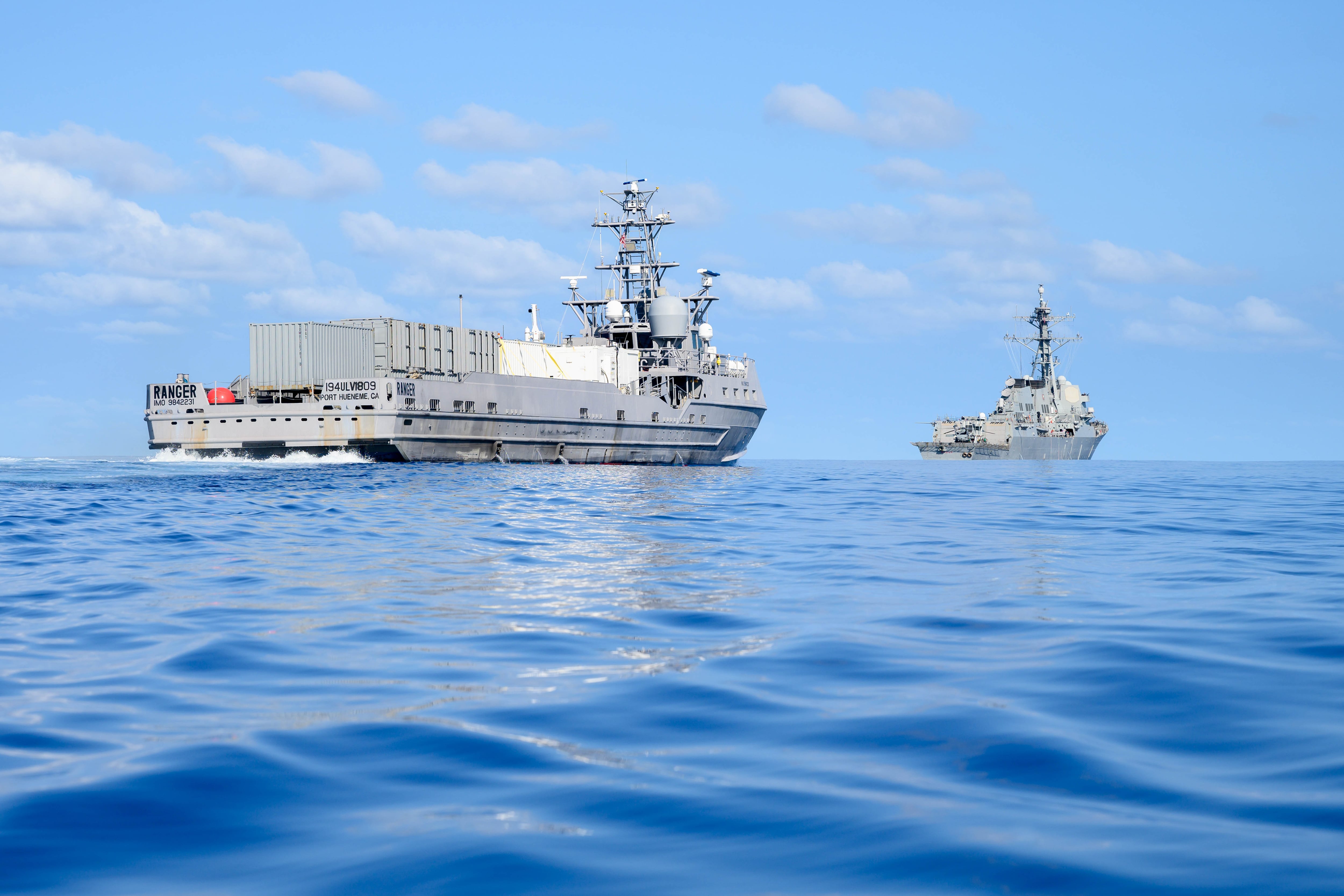
The U.S. medium-sized unmanned service vessels fleet could jump from roughly four to 30 vessels by 2030 in the Indo-Pacific, according to officials.
As of now, the U.S. has at least four medium-sized unmanned service vessels that previously completed deployments in the region.
In just four years, that amount could be approximately seven times larger, according to U.S. Navy Capt. Garrett Miller.
Speaking on a panel about uncrewed maritime systems on Monday’s Sea-Air-Space Conference, Miller, the commodore of Surface Development Group 1, said that based on the service’s 2045 force vision, people can expect to see over 30 medium USVs in the Indo-Pacific.
At the conference, he said that alongside the medium USVs, the service expects there to be thousands of small USVs and any number of unmanned aircraft systems that are operating from either manned or unmanned ships in that region.
The four USVs that were deployed in the Indo-Pacific for five months in 2024 were the Sea Hunter, Sea Hawk, Mariner and Ranger vessels, and all four are still being used to further develop the Navy’s USV program.
In early 2026, Miller announced at the Surface Navy Association’s 38th National Symposium the creation of three USV divisions and that the Sea Hawk and Sea Hunter medium USVs were slated to be deployed this year.
While answering an audience member’s question about the service’s ambition for an uncrewed fleet size during Monday’s conference, Miller clarified that those numbers are strictly for the Indo-Pacific and nowhere else at this point.
The service is “figuring out” what those numbers will look like elsewhere, Miller said on the panel.
Miller said that the service has a “holistic approach” of how they are discussing the number of vessels in regards to where they should house and maintain the potential medium USVs.
The commodore explained that the service needs to look at the numbers in a “broader way” and look toward the Robotic and Autonomous Systems strategy, which aims to build a fleet of manned and unmanned vessels.
He said that the service is going down a path that will allow them to expand at a faster pace than thought previously with any other type of vessel.
“I think you’re going to see things overseas. You’re going to see things in theaters, right?” Miller said.
“These unmanned circuit special squadrons in these theaters are going to be operating and maintaining a lot of those things, along with a contractor-led higher-level maintenance,” Miller concluded.
Cristina Stassis is a reporter covering stories surrounding the defense industry, national security, military/veteran affairs and more. She previously worked as an editorial fellow for Defense News in 2024 where she assisted the newsroom in breaking news across Sightline Media Group.