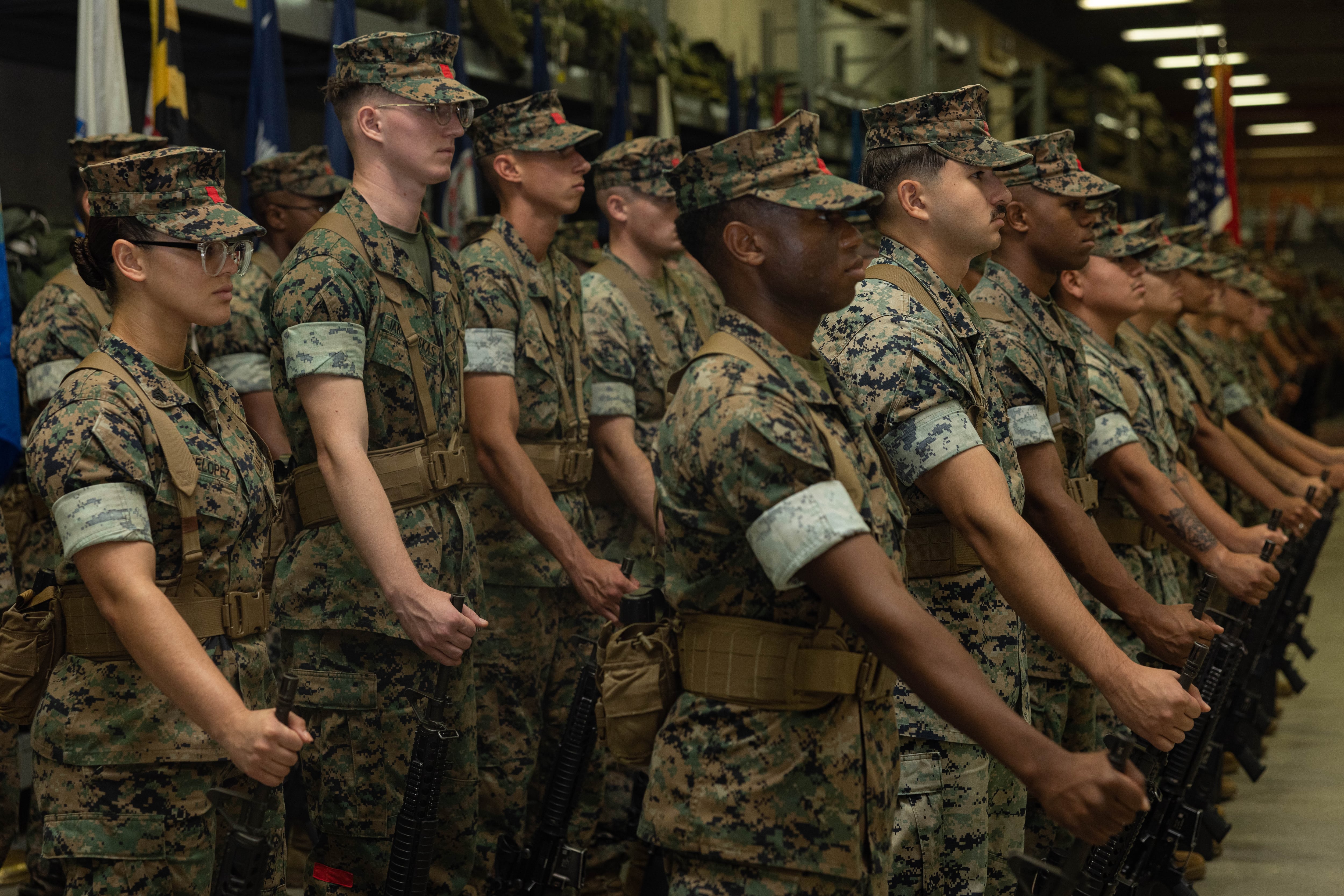
U.S. service members will receive a 3.8% pay increase beginning Jan. 1 under the final version of the annual defense bill announced by the House and Senate on Sunday night.
The proposed fiscal 2026 National Defense Authorization Act makes several changes to Defense Department personnel policy, including a 3.8% across-the-board military pay raise consistent with the Trump administration’s proposed budget request, as well as personnel policy alterations designed to improve troops’ quality of life.
Under the bill, service members with families not only will receive a pay raise, they also will get more money each month when they deploy or are separated from their families for 30 days or more for training or other reasons.
The legislation increases family separation allowance from $250 to $300 per month.
RELATED
It also allows expecting parents to use their parental leave within two years after the birth or adoption of a child and aims to make improvements to military and family housing.
“We’re pleased to announce that the House and Senate Armed Services Committees have reached a bipartisan, bicameral agreement on the FY26 NDAA that supports service members and strengthens our national defense,” chairmen and ranking members of the House and Senate Armed Services Committees — Rep. Mike Rogers, R-Ala., Rep. Adam Smith, D-Wash., Sen. Roger Wicker, R-Miss., and Sen. Jack Reed, D-R.I. — said in a statement Monday.
The proposed legislation authorizes $900.6 billion for the department, more than $8 billion over the president’s budget request. While the bill authorizes the higher amount, congressional appropriators, who dictate the actual funding, will determine the legislation’s final top-line, which could shift as a result.
However, defense appropriators have signaled that they will protect the 3.8% pay raise proposed by Trump. The increase means that an E-4 with four years of service would see a boost in base pay of roughly $134 a month.
The increase in family separation allowance follows a refusal by the Defense Department to increase the amount paid to those separated from their family for at least 30 days or more. Congress in the fiscal 2024 National Defense Authorization Act allowed DOD to boost the $250 per month allowance to up to $400 a month, but the department never implemented an increase.
The new bill alters the law to ensure that at least $300 a month minimum is paid for the allowance with a top-line of $400 per month.
Under the legislation, active-duty service members and activated Guard and reserve members also will be able to take parental leave at any time up to two years after the birth or adoption of a child.
The services’ policies currently allow active-duty service members and activated Guard and reserve members to take up to 12 weeks of leave if they give birth, have a spouse who gives birth, adopt a child or become foster parents. But the leave must be taken within 12 months of the birth or adoption event — a limitation that often prevented service members from taking their full leave especially in years when they moved or deployed.
The two-year extension request must be approved by the first general or flag officer in a service member’s chain of command — a change that prevents commanders from denying the leave.
An item not included in the bill that was originally was in both the House and Senate versions is the expansion of coverage for in vitro fertilization for troops and spouses. The Defense Department covers the process for service members whose infertility is related to service-connected injury or illness, but all others must pay out-of-pocket, either at cost at a limited number of military hospitals or in the private sector.
Sen. Tammy Duckworth, D-Ill., a co-sponsor of the IVF proposal, said Sunday that House Speaker Mike Johnson was working to kill the provision. Johnson had succeeded in removing the proposal from the bill from last year’s House NDAA and appears to have done it again in last-minute negotiations.
“[Johnson’s] stripping away something that a bipartisan group in Congress has said, ‘You know what, we want our military men and women and their families to be able to have access to IVF.’” Duckworth said Sunday on CNN’s State of the Union show. “The president of the United States promised on the campaign trail to make IVF available to all Americans. And I can’t think of a better place to make it available than the men and women who wear the uniform of this great nation.”
Johnson’s office did not reply to a request for comment by publication. Johnson released a statement Sunday on the NDAA, praising the legislation but not mentioning the IVF provision.
Johnson said the bill, as it stands, codifies presidential orders that address “woke ideology at the Pentagon, securing the border, revitalizing the defense industrial base and restoring the warrior ethos.”
“Under President Trump, the U.S. is rebuilding strength, restoring deterrence, and proving America will not back down. President Trump and Republicans promised peace through strength. The FY26 NDAA delivers it,” Johnson said.
The legislation includes a provision that bars transgender persons from serving on women’s athletic teams at U.S. service academies, in compliance with a Jan. 20 executive order by Trump that recognizes two sexes — male and female — in the federal government.
But it also creates the reestablishment of “women’s initiative teams” in each of the service departments to study and address barriers for women in recruitment, retention and professional advancement.
The inclusion of the reinstatement of the teams — a proposal by Rep. Chrissy Houlahan, D-Pa., an Air Force veteran, and others — is a direct rebuke of Defense Secretary Pete Hegseth’s decision to eliminate the teams and other offices that address gender equality in the services.
Hegseth in September also disbanded the Defense Advisory Committee for Women in the Services after saying earlier in the month that it would be reinstated after a review. In announcing the termination, Hegseth said the committee was “divisive” and focused on “advancing a … feminist agenda that hurts combat readiness.”
“I am proud that this year’s bipartisan bill continues to fortify the work and provisions of the Quality of Life panel [part of the House Armed Services Committee] while addressing the urgent technological and strategic needs of our military,” Houlahan said in July while working to have protection of the women’s teams placed into the bill.
As part of an effort to reduce service members’ risk of head injury during training, the bill also creates 10 new positions across the services, including blast safety officers responsible for overseeing assessments and risk management related to overpressure caused by weapons handling and firing.
The officers are to ensure that military personnel understand the health risks of blast exposure and follow protocols for decreasing risk, including personal protective equipment, adhering to minimum safe distance rules in training and using sensors to collect data on exposure.
The Defense Department announced last year several new measures to protect troops from overpressure injuries caused by weapons use, including safe distances and cognitive assessments.
The bill does not include any references to changing the name of the department to the Department of War as Hegseth and Trump now refer to it. Congressional approval is required for a formal name change.
The House is expected to vote on the bill this week, with the Senate expected to address it the week of Dec. 15 before it heads to Trump’s desk to become law.
Patricia Kime is a senior writer covering military and veterans health care, medicine and personnel issues.