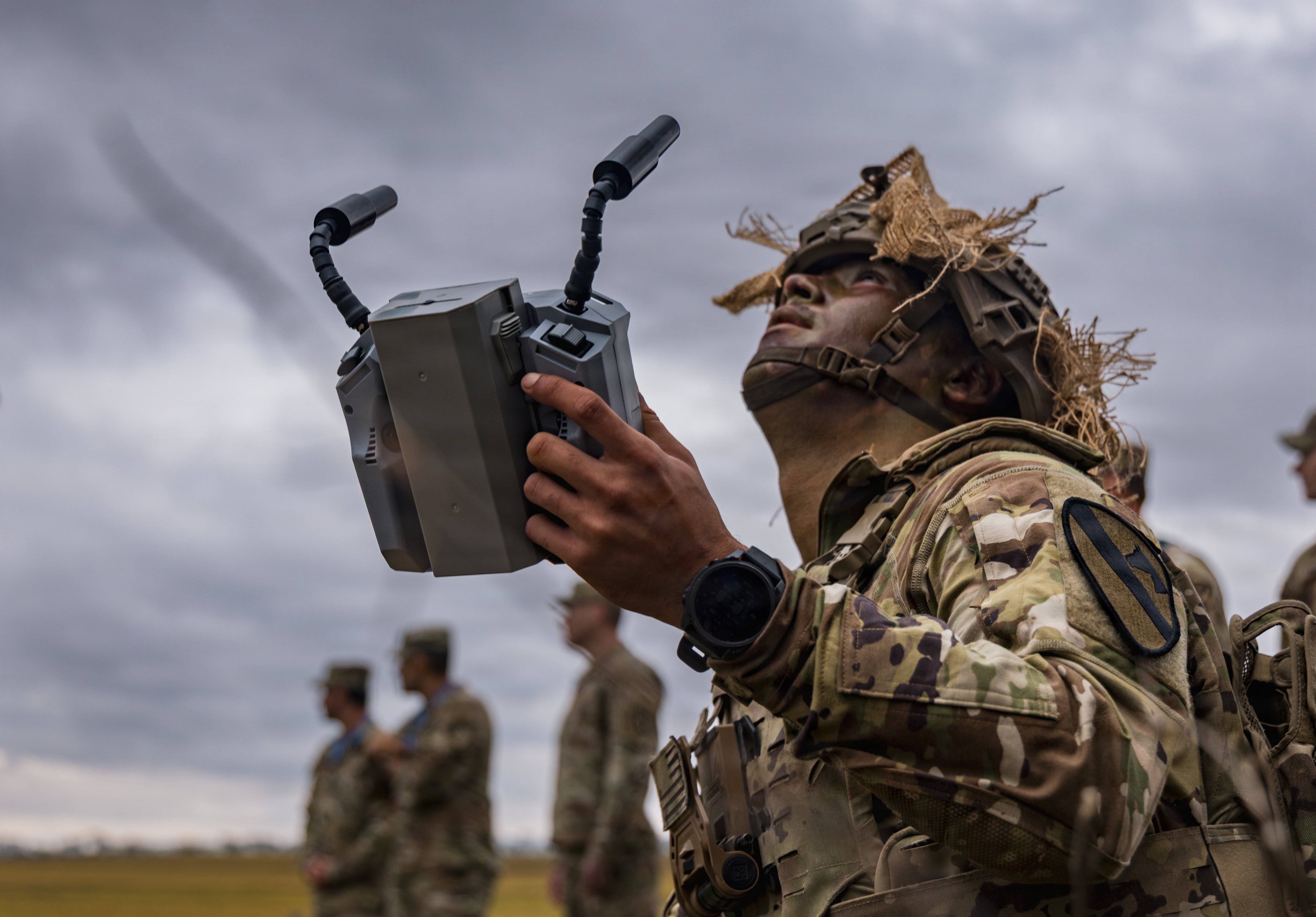
HUNTSVILLE, Alabama — Soldiers from across the U.S. Army showcased drone warfare skills and ideas in the service’s first annual Best Drone Warfighter Competition held here this week.
The competition, launched on Tuesday, is an Army event sponsored by the Army Aviation Association of America. It drew over 800 attendees and competing teams drawn from every Army unit.
It mirrors existing Army competitions such as Best Sapper, Best Ranger and Best Sniper, with emphasis on drone warfare. Soldiers compete in three lanes for the titles of Best Operator, Best Tactical Hunter-Killer Team, and Best Innovation.
The lanes include a drone racing obstacle course, a cross-country field exercise in which soldiers pair up to take out targets, and an innovation lane which sees soldiers showcase drone technology they’ve developed to a panel of five judges.
Prioritizing soldier ideas
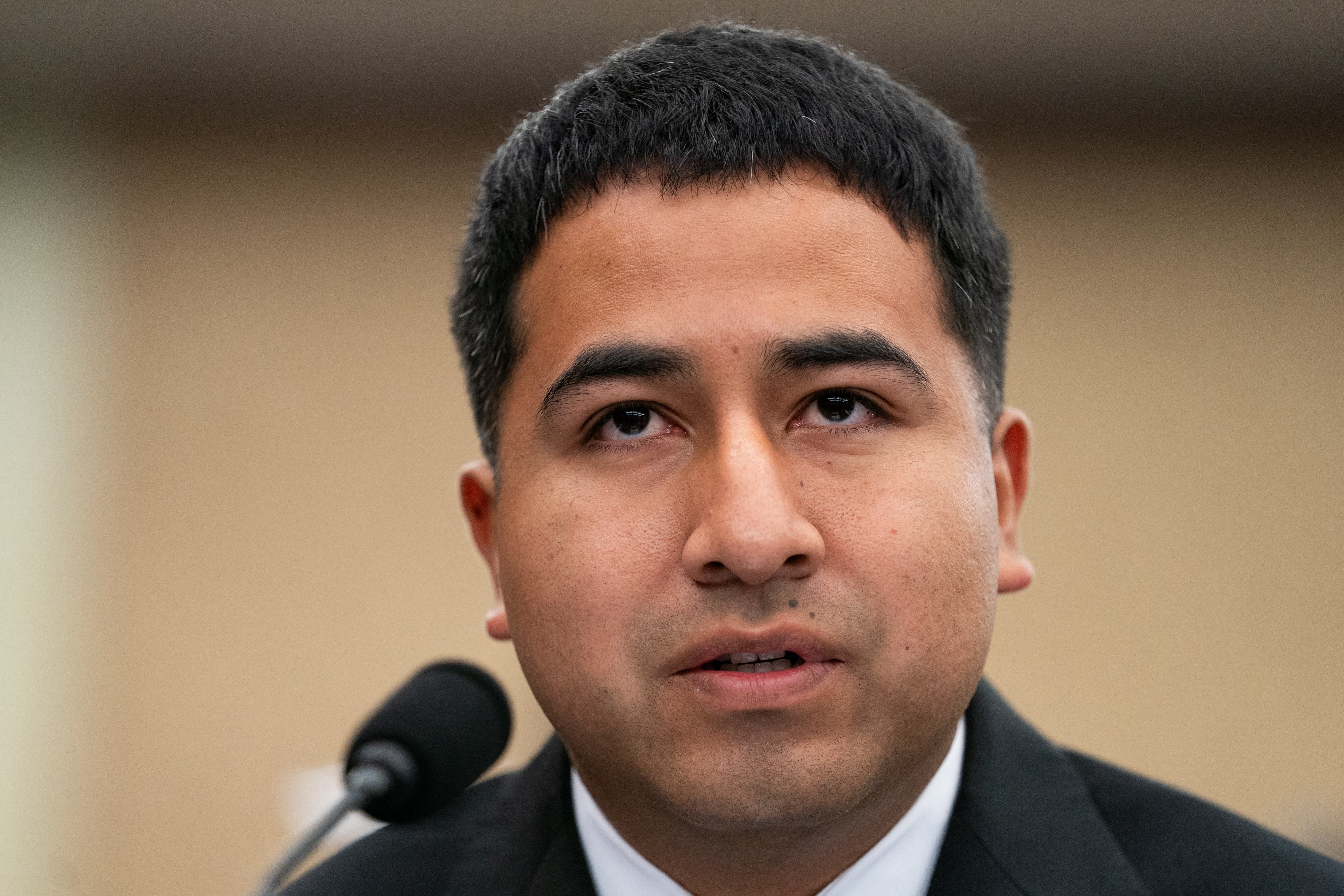
“These lanes absolutely inform and tell us what kind of skills we need to train to make them the best at what we expect them to do,” Col. Nicholas Ryan, director of Army UAS Transformation and Lessons Learned Manager at the Army’s Aviation Center of Excellence, told Military Times.
The focus of the competition is not on gaining points or acclaim but developing recipes for success in the unmanned domain, Ryan said.
All lanes focus on gathering input from soldiers about what drone technology is proving effective and why, encouraging participants to share solutions.
Additionally, the innovation lane gives soldiers experience with building and modifying their drone equipment - an essential skill in the fast-moving domain.
“That fabrication and modification aspect is also something we’ve taken from Ukraine because that’s what their operators do and it’s necessary for them to adjust their equipment to meet their mission demands,” Ryan said.
“It is now built into our UAS training courses teaching them how to 3-D print, how to design, how to code and how to build their own drones.”
What makes a good drone operator?
Soldiers competing in the Best Operator lane raced Neros Archer FPV drones. The Neros was chosen to establish a baseline for competitors to showcase their skills on a standard drone platform, offering a modular design that is easy to repair.
The lane saw soldiers fly drones through an intricate obstacle course and perform complex maneuvers.
While some operators were not used to racing, Captain Jacob Bickus, officer in charge of the Army Drone Team, told Military Times that hands-on practice is essential to build skills through familiarity.
“Even though it’s racing, it’s still good practice for them to build their skills,” Bickus said.
Asked what makes a good drone operator, Bickus told Military Times that the most important quality is to have an open mind.
“They have to be creative and innovative, and have an engineer problem-solving mindset because with these drones there are so many intricacies and knowledge you have to have to be able to proficiently operate them,” he said.
Drone swarms and autonomy
Future iterations of the Army competition event could incorporate drone swarm tactics, though that depend on the pace of developing technology, Ryan told Military Times.
“We absolutely want it in the Army, and want to use it in the Army. It’s not there just yet,” he said.
“That is absolutely a task and a requirement we do want to incorporate which we refer to as the one-to-many control, so one operator controlling many drones simultaneously.”
As drones are now an essential tool within the Army, the competition will help identify how the service can strengthen existing capabilities, Ryan explained.
“What we’re seeing is that is going to be a common capability and piece of equipment across every formation of every type and any group of soldiers,” Ryan said.
He added that fully autonomous systems may be suitable to performing some basic tasks for the Army in the future.
“There will be so many mission sets that drones can do and various types of technology across ranges of autonomy, and that’s something that we’re looking at very closely as well.”
Zita Ballinger Fletcher previously served as editor of Military History Quarterly and Vietnam magazines and as the historian of the U.S. Drug Enforcement Administration. She holds an M.A. with distinction in military history.