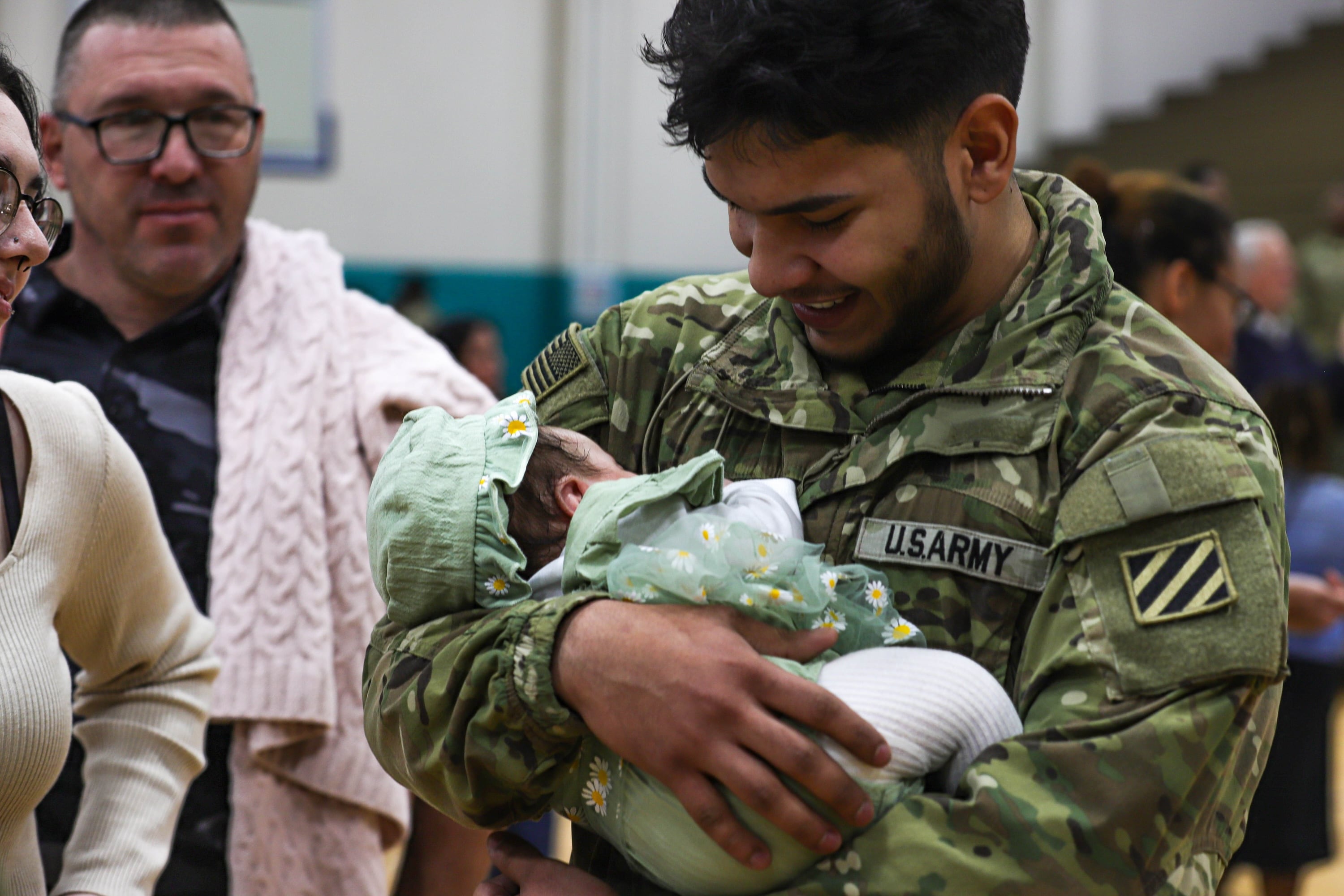
Over the last two decades, the Army and Defense Health Agency have made meaningful progress in perinatal care and support. Yet despite expanded screening, education and policy attention, a critical population remains largely invisible and unconsidered: fathers and nonbirthing partners, such as adoptive parents or caregiving partners, among others.
This omission is not without consequence. One of the strongest predictors of birthing mothers’ mental health is partner support. That finding is not new, controversial or theoretical. A partner’s capacity to provide support is directly shaped by their own psychological health; when nonbirthing partners experience untreated distress, depression or anxiety this predictably erodes their ability to support the birthing partner.
Further, perceived partner support during pregnancy lowers maternal emotional distress postpartum, and even correlates with reduced distress in infants, demonstrating the importance of supportive relationships in both parent and child well-being.
Decades of research and federal policy discussions, including the last two National Defense Authorization Acts, acknowledge the importance of family mental health by framing access to behavioral health care and early identification of risk as readiness priorities — emphasizing prevention during periods of elevated risk. In practice, however, clinics screen birth mothers, while the nonbirthing partners’ mental health remains virtually ignored. That is until a crisis forces attention. Such crises could be prevented or significantly reduced if partners were intentionally screened and supported. Preventative care for partners remains largely absent.
Even setting aside the growing body of evidence that fathers experience significant psychological and emotional changes during the pregnancy and postpartum period, the readiness argument alone should demand change. Men account for almost 84% of the active-duty Army. That means the majority of the force is navigating the perinatal period and transition to parenthood — a time of known increased risk — without formalized support. Research indicates approximately 8% to 10% of new fathers experience significant depressive symptoms, some studies show up to 15% or higher when anxiety is included — rates likely mirrored in the active-duty population. These unmet mental health needs very likely affect new parents’ readiness and performance.
If we are serious about force readiness, we should work to identify and mitigate risk before it manifests as untreated psychological distress, substance misuse, family violence or relationship dissolution. These outcomes do not just affect individual families, they degrade unit readiness, retention and long-term force health.
Currently, pregnant service members and Tricare beneficiaries have the opportunity to be screened for depression an estimated 10 to 15 times before the child is even born. Yet clinical practice guidelines do not recommend screening nonbirthing partners.
This gap in parental support extends beyond health care. Active Army pregnant service members are also enrolled in Pregnancy Postpartum Physical Training, or P3T, which at most installations includes one day of education a week that covers topics such as emotional regulation, relationship changes and available resources to support the entire family system. Yet no comparable standardized touchpoints exist for partners, despite their central and critical role in maternal and infant outcomes.
The absence of screening and education for the partner does not reduce the burden. Instead, it shifts it by implicitly placing responsibility for the entire family system’s psychological well-being (and ability to triage it with resources) on the mother at a time when she herself is navigating immense physical, emotional and relational change.
A pilot initiative underway at Fort Carson suggests what many clinicians already know: Fathers want to be involved. They care; they simply lack a platform, language and an invitation to engage. When given structured opportunities, they participate.
This initiative meets nonbirthing partners once per trimester and twice postpartum (6 weeks and 3 months) to screen for depression, emotional lability and relational distress. It provides psychoeducation aligned with their stage in the perinatal period and shares resources to support them and their family. Supporting the entire family system is not a distraction from maternal care but an enhancement to it.
To address this gap, DHA should build on pilot initiatives like the one at Fort Carson, which systematically engages nonbirthing partners throughout the perinatal period. This means implementing routine screenings for depression, anxiety and relational stress; providing stage-specific psychoeducation; and connecting partners to resources that support both their well-being and the family system.
Additionally, this calls for DHA to invest in research to better understand the experiences of fathers and nonbirthing partners, using these insights to develop evidence-based standards of care that fully integrate the entire family into perinatal support.
This is not just a maternal health issue — it is a population health and readiness issue, and addressing it proactively strengthens families, service members and the Army as a whole.
Capt. Lauren Finch currently serves as an active-duty Army behavioral health officer and licensed social worker currently at Fort Carson, Colorado. She has served in both operational and clinical roles, and holds a Master of Social Work through the Army’s program through the University of Kentucky. Her work focuses on perinatal mental health, family readiness, retention and policies, and improving behavioral health access and outcomes for the family system. The views expressed are those of the author and do not reflect the official policy of the department of the Army, Defense Health Agency, the Defense Department or the U.S. government.